



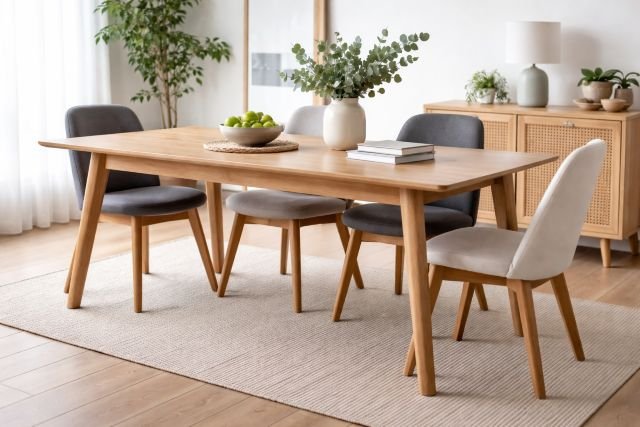
A table with wooden legs is one of those rare furniture choices that can look timeless and feel practical at the same time. It brings warmth to modern spaces, adds character to minimalist rooms, and pairs easily with everything from rustic décor to Scandinavian style. But not all wooden-leg tables are created equal — leg shape, joinery, wood species, and finish can change how stable the table feels, how long it lasts, and how well it fits your day-to-day life.
- Why tables with wooden legs never really go out of style
- Table with wooden legs: what to look for first (before style)
- Choosing the right style: leg shapes that change the whole vibe
- Sizing that actually works: table dimensions and clearance
- Materials and finishes: how to balance looks with real-life durability
- A simple way to match the table to your room
- Sustainability and sourcing: what “responsible wood” really means
- Common questions people ask before buying
- Conclusion: choosing a table with wooden legs that you’ll love long-term
In this guide, you’ll learn how to pick the right table with wooden legs based on your room size, style goals, durability needs, and budget — plus how to avoid common “wobbly table” mistakes and choose more responsible materials.
Why tables with wooden legs never really go out of style
Wooden legs soften a room visually. Even when your tabletop is glass, stone, or laminate, wood legs add a natural element that makes the whole piece feel less “cold.” That’s why you’ll see wooden legs everywhere — from modern dining rooms to cozy café corners.
There’s also a practical advantage: well-built wood furniture is often repairable. Scratches can be sanded, finishes can be refreshed, and small dents can become part of the patina instead of a permanent eyesore. That repairability is a big reason solid wood furniture can last for decades when cared for properly.
Table with wooden legs: what to look for first (before style)
Before you fall in love with a silhouette, check these fundamentals. They’re the difference between a table that feels sturdy for years and one that starts rocking after a few months.
1) Stability cues you can spot immediately
A stable table usually has:
- legs that are thick enough for the tabletop size (thin legs on a heavy top can feel “springy”)
- a wide stance (legs closer to corners generally feel steadier)
- solid joinery (tight connections where legs meet the apron/frame)
Wooden legs can be very stable, but stability depends on more than material — leg thickness, placement, and the way the base is engineered matter a lot.
2) Joinery and frame support (the underrated hero)
If your table has an apron (the frame under the tabletop), that can add stiffness and reduce wobble. For larger dining tables, a strong apron or stretcher can make a noticeable difference — especially on uneven floors.
3) Wood type: hardwood vs softwood (and why it matters)
Hardwoods like oak, ash, maple, or walnut are typically more dent-resistant than softer woods like pine. Softwoods can still be a smart choice for lighter-use spaces, but if you’ve got kids, frequent guests, or you plan to keep the table for a long time, hardwood legs tend to hold up better.
Choosing the right style: leg shapes that change the whole vibe
Wood legs aren’t just “wood legs.” Their shape communicates a style language.
Straight legs (clean and modern)
Straight legs are the easiest to pair with modern, minimalist, and Scandinavian interiors. They’re also visually quiet, which helps if you want your chairs, lighting, or rug to be the star.
Tapered legs (mid-century modern energy)
Tapered legs create a lighter, more elevated look. They often work best on smaller-to-medium tables where the top isn’t extremely heavy.
Turned legs (classic and farmhouse)
Turned legs are decorative and traditional. They look great with rustic wood tops, vintage-inspired dining chairs, and warmer color palettes.
Splayed legs (designer feel, but check engineering)
Splayed legs can look architectural and stylish, but the angles must be engineered well. If not, you may notice side-to-side movement over time, especially if the table gets dragged across the floor.
Sizing that actually works: table dimensions and clearance
A table can be gorgeous and still feel wrong if it’s too big for the room—or too small for how you live.
Dining table sizing guidelines (quick reality check)
A commonly cited rule of thumb is to leave enough clearance around the table so people can slide chairs out and walk behind seated guests. Many furniture guides recommend planning for comfortable circulation space around the table area.
West Elm’s general sizing guide is a helpful starting point for how many people typical table lengths seat (for example, 48″ often seats 4; 60–72″ often seats 6; 80–87″ often seats 8).
If your space is tight, a round table can improve flow because you don’t have sharp corners and you often gain more usable walking space.
Desk or console table sizing
For work tables, stability matters more than people realize. If you’ll type, write, or use a monitor arm, a stiff base (good joinery + strong frame) helps reduce wobble. Some ergonomics-focused furniture resources explicitly call out wobble control as part of comfort and performance in workstations.
Materials and finishes: how to balance looks with real-life durability
This is where many buyers get surprised. Two tables can look similar online, but behave totally differently in daily use.
Solid wood vs veneer vs MDF (what it means for the legs)
If the legs are truly solid wood, they’re usually more forgiving over time because wood can be refinished and repaired. Composite materials like MDF and particleboard are common in budget furniture, but they can be more vulnerable to swelling or breakdown if moisture gets in.
There are also indoor air quality considerations with composite wood products, because some use resins that can emit formaldehyde. In the U.S., composite wood products are regulated under TSCA Title VI (formaldehyde emission standards), and compliant products are labeled accordingly.
Practical takeaway: if you’re choosing a table that uses engineered components, look for compliant labeling and choose reputable brands that disclose materials clearly.
Finish types: what to choose for your lifestyle
If your table is going into a high-traffic dining area, you want a finish that resists water rings and stains. Many manufacturers use durable clear coats (often polyurethane or similar protective finishes). If you prefer a natural matte look, make sure you understand the maintenance — some low-sheen finishes look amazing, but they may require coasters and quick wipe-downs to stay pristine.
A simple way to match the table to your room
If you’re stuck between “warm and cozy” versus “clean and modern,” use this pairing logic:
- Modern space, lots of hard surfaces (tile, glass, metal): a table with wooden legs adds warmth and reduces the “echo chamber” feel visually.
- Traditional or rustic space: turned legs or chunkier straight legs reinforce the cozy, grounded mood.
- Small apartment: consider slimmer legs, a lighter wood tone, and a round or oval shape for flow. (Curated small-space guidance often emphasizes compact sizing and base choices like pedestal vs four legs depending on legroom and layout.)
Sustainability and sourcing: what “responsible wood” really means
If sustainability matters to you (or you just want peace of mind about sourcing), certifications can help.
FSC certification (what it signals)
FSC (Forest Stewardship Council) is one of the most widely recognized forest certification systems. FSC publishes data and reporting on certification and chain-of-custody efforts, and academic literature frequently references FSC’s global reach.
A practical shopper’s tip: look for FSC-certified wood claims and chain-of-custody language when available, especially for brands that provide sourcing transparency.
A real-world caution
Certification is helpful, but it isn’t magic. Investigations and research have raised concerns in some supply chains about mislabeling of origin in certain wood products, highlighting the importance of transparency and enforcement.
If you want to go a step further, consider brands that publish sourcing regions, species details, and third-party documentation rather than just a logo.
Common questions people ask before buying
What’s the most durable table with wooden legs?
Look for solid hardwood legs (like oak, ash, or maple), thick leg profiles relative to the tabletop, and strong joinery with an apron or stretcher support. Well-built solid wood furniture is often discussed as a multi-decade purchase when maintained well.
Do wooden table legs wobble more than metal?
Not necessarily. Wobble is usually a design and construction issue (leg geometry, joinery, frame stiffness), not a simple “wood vs metal” verdict. Some stability guidance specifically points to leg shape, thickness, and overall engineering as key factors.
How do I stop a table from wobbling on uneven floors?
Start with adjustable floor levelers or felt pads. If the wobble persists, check whether the joints are tightening properly. Persistent wobble can also be a sign the table frame is underbuilt for the top size.
Are tables with engineered wood unsafe?
Many engineered wood products are regulated for formaldehyde emissions (for example, under EPA TSCA Title VI in the U.S.), and compliant products are labeled. If indoor air quality is a priority, look for compliant labeling and transparent material disclosures.
Conclusion: choosing a table with wooden legs that you’ll love long-term
The best table with wooden legs is the one that fits your space, matches your lifestyle, and stays stable through daily use. Start with fundamentals — room measurements, clearance, and a base design that supports the tabletop properly — then narrow down your preferred leg style (straight, tapered, turned, or splayed). Pay attention to wood type, joinery, and finish, because those details determine whether your table ages gracefully or becomes a maintenance headache.
If sustainability matters, look for credible sourcing signals like FSC-related transparency and documentation. And if you’re buying engineered components, check for compliance labeling and clear material disclosures tied to recognized standards.