



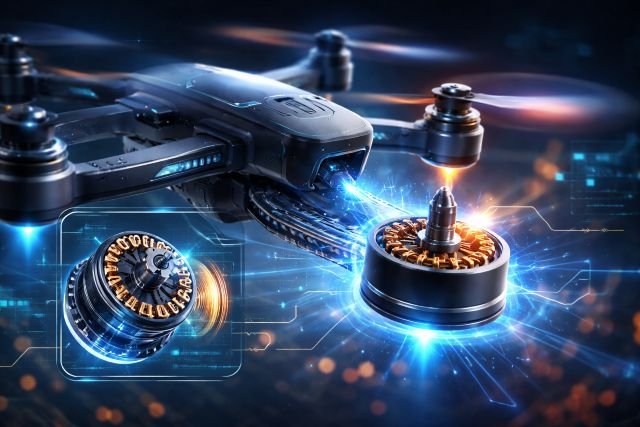
Drones have revolutionized industries ranging from aerial photography to agriculture and logistics. At the heart of every drone’s performance lies a critical component: drone motors. These small yet powerful devices convert electrical energy into mechanical motion, allowing drones to lift off, hover, maneuver, and land smoothly.
- What Are Drone Motors?
- The Basic Working Principle of Drone Motors
- Why Brushless Drone Motors Are So Powerful
- Key Components of Drone Motors
- How Drone Motors Control Flight Movement
- KV Rating: A Key Specification of Drone Motors
- How Drone Motors Affect Flight Performance
- How Propellers Work with Drone Motors
- Cooling and Heat Management in Drone Motors
- Common Problems with Drone Motors
- Tips for Choosing the Right Drone Motors
- Future Innovations in Drone Motor Technology
- FAQ: How Drone Motors Work
- Conclusion
Understanding how drone motors work can help drone enthusiasts, hobbyists, and professionals optimize flight performance, improve efficiency, and extend the lifespan of their aircraft. In this comprehensive guide, we’ll explore the technology behind drone motors, the types available, and the secrets to achieving faster and smoother drone flights.
What Are Drone Motors?
Drone motors are electric motors responsible for spinning the propellers that generate thrust. When the propellers rotate, they push air downward, creating an upward force that lifts the drone into the air.
Most modern drones rely on brushless electric motors, which are known for their efficiency, durability, and power. These motors operate through electromagnetic principles that convert electrical energy from the drone’s battery into rotational motion.
According to research published by the Massachusetts Institute of Technology (MIT), efficient propulsion systems are essential for improving drone endurance and flight performance.
The efficiency of drone motors directly influences:
- Flight speed
- Stability and control
- Energy consumption
- Payload capacity
Without well-designed motors, drones would struggle to maintain stable flight.
The Basic Working Principle of Drone Motors
To understand how drone motors operate, we need to look at their internal structure and the electromagnetic principles behind them.
Inside a typical brushless motor, there are three primary components:
1. Stator
The stator is the stationary part of the motor. It contains copper wire windings arranged in coils. When electricity flows through these coils, they create a magnetic field.
2. Rotor
The rotor is the rotating part of the motor. It usually contains permanent magnets. When the stator’s magnetic field interacts with the rotor’s magnets, rotational motion occurs.
3. Electronic Speed Controller (ESC)
The ESC controls the speed of the motor by adjusting the current supplied to the stator coils. It determines how fast the propellers spin.
When the flight controller sends commands to the ESC, the ESC adjusts motor speed accordingly. Faster spinning propellers generate more thrust, allowing the drone to climb or accelerate.
The continuous adjustment of motor speed allows drones to hover, tilt, and perform complex maneuvers.
Why Brushless Drone Motors Are So Powerful
Modern drones rely almost exclusively on brushless drone motors because they offer several advantages over traditional brushed motors.
Brushless motors eliminate mechanical brushes, which reduces friction and wear. This results in longer lifespans and improved efficiency.
Some key advantages include:
Higher efficiency means more energy from the battery is converted into motion. This leads to longer flight times.
Reduced heat generation improves reliability during extended flights.
Higher RPM (rotations per minute) enables faster propeller speeds, which increases thrust.
The Federal Aviation Administration (FAA) highlights propulsion efficiency as a key factor in drone performance and safety.
Because of these benefits, brushless motors dominate consumer drones, racing drones, and professional UAV systems.
Key Components of Drone Motors
Understanding the internal components of drone motors can reveal why certain models perform better than others.
Copper Windings
The copper windings inside the stator carry electrical current. The quality and thickness of these wires influence the motor’s efficiency and heat resistance.
Permanent Magnets
High-quality neodymium magnets are commonly used in drone motors. These powerful magnets allow stronger electromagnetic interactions, resulting in higher torque.
Bearings
Bearings reduce friction in the rotating shaft. High-quality bearings allow smoother rotation and improve flight stability.
Motor Shaft
The shaft connects the rotor to the propeller. Its strength determines how well the motor can handle stress during rapid acceleration.
Each of these components plays a role in ensuring smoother and more efficient drone flights.
How Drone Motors Control Flight Movement
A drone does not rely on a single motor. Instead, most drones use four motors, a configuration known as a quadcopter.
Each motor spins a propeller either clockwise or counterclockwise. This balanced rotation prevents the drone from spinning uncontrollably.
Flight movement occurs when the drone adjusts the speed of specific motors.
For example:
If the front motors slow down while the rear motors speed up, the drone tilts forward and moves ahead.
If motors on one side spin faster than the other, the drone rolls sideways.
Precise motor control enables drones to perform complex aerial maneuvers with remarkable stability.
According to research published in IEEE robotics journals, precise motor control algorithms are essential for autonomous drone navigation.
KV Rating: A Key Specification of Drone Motors
When shopping for drone motors, you’ll often see a specification called KV rating.
KV refers to the number of rotations per minute (RPM) the motor produces per volt of electricity.
For example:
A 1000 KV motor will spin at approximately 1000 RPM per volt without load.
If powered by a 10V battery, the motor can theoretically reach 10,000 RPM.
Low KV motors generate more torque and are ideal for heavy drones or aerial photography rigs.
High KV motors spin faster and are commonly used in racing drones.
Choosing the correct KV rating significantly impacts speed, efficiency, and flight stability.
How Drone Motors Affect Flight Performance
The quality and design of drone motors directly influence how a drone behaves in the air.
Speed
Higher RPM motors allow drones to accelerate quickly and reach greater speeds. Racing drones often use extremely high-speed motors for competitive performance.
Stability
Smooth motor operation reduces vibration, which helps maintain steady camera footage.
Efficiency
Efficient motors consume less power, allowing drones to fly longer before the battery needs recharging.
Payload Capacity
Powerful motors enable drones to carry heavier payloads such as professional cameras or sensors.
Manufacturers carefully balance these factors to design drones for specific applications.
How Propellers Work with Drone Motors
While drone motors generate rotation, propellers convert that rotation into thrust.
Propeller size and pitch play a major role in flight behavior.
Larger propellers move more air, creating stronger lift.
Higher pitch propellers increase forward speed but may require more powerful motors.
Matching the right propellers with the correct motors is essential for optimal performance.
NASA research on rotorcraft aerodynamics emphasizes how propeller design impacts thrust generation and efficiency.
Cooling and Heat Management in Drone Motors
High-performance drone motors generate heat during operation.
To prevent overheating, manufacturers design motors with cooling features such as:
Ventilation holes in the motor housing.
Aluminum casings that dissipate heat.
Airflow channels created by rotating propellers.
Proper cooling helps maintain efficiency and prevents long-term damage.
Overheating can reduce motor lifespan and affect flight stability.
Common Problems with Drone Motors
Even the best drone motors can encounter issues over time.
One common problem is motor overheating, which may occur due to excessive payload or improper propeller selection.
Another issue is bearing wear, which can cause vibrations and unstable flight.
Debris or dust entering the motor housing can also interfere with smooth rotation.
Regular inspection and maintenance help ensure consistent performance.
Tips for Choosing the Right Drone Motors
Selecting the right drone motors depends on your drone’s purpose.
For aerial photography, low KV motors with larger propellers provide smoother and quieter flights.
For racing drones, high KV motors deliver rapid acceleration and extreme agility.
Motor size, weight, and compatibility with your drone frame also play crucial roles.
Many professional drone builders test multiple motor configurations before finding the optimal setup.
Future Innovations in Drone Motor Technology
Drone propulsion technology continues to evolve rapidly.
Researchers are developing high-efficiency motors, advanced cooling systems, and smarter motor controllers.
Companies are also experimenting with AI-powered flight systems that optimize motor performance in real time.
These innovations could lead to longer flight times, quieter drones, and improved safety.
According to industry analysis by Drone Industry Insights, the global drone market is expected to exceed $50 billion by 2030, driving continued innovation in propulsion systems.
FAQ: How Drone Motors Work
What type of motors do drones use?
Most drones use brushless electric motors because they are efficient, durable, and capable of high speeds.
How many motors does a drone have?
Most consumer drones use four motors in a quadcopter configuration, although some professional drones use six or eight motors.
Why do drone motors spin in opposite directions?
Opposite rotation prevents torque imbalance and keeps the drone stable during flight.
Can drone motors be replaced?
Yes. Most drone motors are modular and can be replaced if damaged or worn out.
Conclusion
Drone motors are the driving force behind every successful flight. By converting electrical energy into rotational motion, these motors power propellers that generate lift and enable drones to maneuver with precision.
From brushless motor design to KV ratings and propeller compatibility, every detail influences how a drone performs in the air. Understanding how drone motors work allows drone pilots and builders to optimize speed, stability, and efficiency.
As drone technology continues to advance, improvements in motor design will play a major role in enabling faster, smoother, and more reliable flights.
Whether you’re a hobbyist experimenting with custom builds or a professional using drones for photography or inspections, mastering the fundamentals of drone motors can significantly enhance your flying experience.