



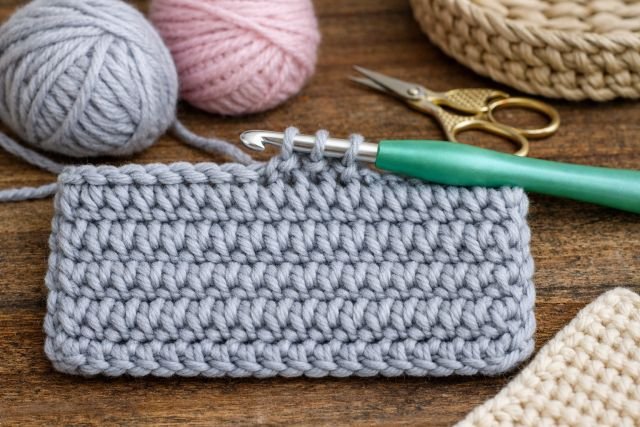
If you’ve ever tried half treble crochet UK and thought, “Why do my rows look wobbly?” or “Why are my edges turning into a staircase?”, you’re not alone. Half treble is one of those stitches that looks simple on paper, yet it instantly reveals tension habits, hook control, and where you place your final stitch.
- What is half treble crochet UK?
- Half treble crochet UK step-by-step (the method that keeps height consistent)
- Half treble crochet UK tension: the real reason stitches look uneven
- How to make a tension swatch for half treble crochet UK (and actually trust it)
- Master neat edges in half treble crochet UK (no more accidental increases)
- Half treble crochet UK height control: how to keep rows stacking evenly
- Half treble crochet UK vs other stitches: when to use it
- Common half treble crochet UK problems (and the fixes that actually work)
- Example scenarios: how half treble crochet UK changes real projects
- Add polish: borders and finishing for half treble crochet UK
- FAQs: half treble crochet UK
- A quick note on why crochet skills are booming again
- Conclusion: your “clean half treble” checklist
The good news is that once you understand how half treble crochet behaves — its height, its “lean,” and how it stacks — your fabric becomes smoother, your edges get tidier, and your projects start looking intentionally professional. This guide is built to help you master three things crocheters care about most: consistent tension, consistent height, and edges that don’t flare, shrink, or drift.
What is half treble crochet UK?
Half treble crochet UK (abbreviated htr) is a foundational stitch that sits between UK double crochet and UK treble crochet in height. It creates a fabric with more drape than a shorter stitch but still feels firm and tidy—great for wearables, blankets, and accessories.
If you’ve come from US patterns, here’s the key translation: UK half treble (htr) is the same stitch as US half double crochet (hdc). This is one of the most common sources of confusion when following patterns from different regions.
Featured snippet definition
Half treble crochet UK (htr) is made by yarning over, inserting the hook into the stitch, yarning over and pulling up a loop (3 loops on hook), then yarning over and pulling through all 3 loops.
That “pull through all 3 loops” is the stitch’s signature. It’s also where tension issues most often show up.
Half treble crochet UK step-by-step (the method that keeps height consistent)
A clean half treble is less about speed and more about repeating the exact same micro-movements each time.
To work an htr stitch in UK terms:
Start with a yarn over (yoh), insert into the next stitch, yarn over and pull up a loop (you’ll have three loops on the hook), yarn over again, then pull through all three loops to complete the stitch.
If your stitch height is inconsistent, focus on one moment: the height of the loop you pull up. Pulling up a tall loop makes the htr look loose and tall. Pulling up a short loop makes it squat and tight. Your goal is a consistent pull-up height every time.
Pro tip for even height
After you pull up the loop (3 loops on hook), pause for half a second and gently “set” the loop to the height you want before the final yarn-over and pull-through. That tiny pause prevents accidental tall spikes.
Half treble crochet UK tension: the real reason stitches look uneven
In UK crochet, many makers use the word tension where US patterns say gauge. Either way, it’s the same idea: how many stitches and rows you produce in a measured square of fabric, influenced by yarn, hook, and how you personally hold and feed yarn.
When your half treble tension is off, you’ll usually see one of these outcomes:
Loose tension: gaps between stitches, edges that ripple, fabric that feels floppy.
Tight tension: stiff fabric, hard-to-insert hook, edges that pull inward, and your rows look shorter than expected.
Why half treble highlights tension issues
Half treble has a yarn over, a pull-up loop, and a final pull-through of three loops. That’s multiple chances for the yarn to tighten or loosen based on how you move your hook and how you feed yarn. It’s “forgiving” enough to work fast, but not forgiving enough to hide inconsistent tension.
How to make a tension swatch for half treble crochet UK (and actually trust it)
If you want reliably sized garments or panels that join neatly, swatching is the difference between guessing and knowing.
A widely used standard approach is to make a swatch (often around 4 inches square, though patterns may specify), measure stitch and row counts, and adjust hook size if needed.
Here’s the detail crocheters skip that changes everything: treat your swatch the same way you’ll treat your final item. If the finished item will be washed or blocked, the swatch should be washed or blocked too, because fabric can relax and measurements can change after finishing.
Micro-adjustments that fix half treble tension fast
If you’re only slightly off, you don’t always need a new hook. Try adjusting just one variable:
If your stitches are too tall and loose, pull up a slightly shorter loop and keep your yarn feed closer to the hook.
If your stitches are too tight, relax your grip and intentionally pull up a slightly taller loop before completing the stitch.
These tiny changes matter more in half treble than in many other basics because half treble’s height is largely “decided” at the pull-up stage.
Master neat edges in half treble crochet UK (no more accidental increases)
Most messy edges come from one of two mistakes:
Missing the last stitch of the row, which gradually narrows your work.
Working into the turning chain incorrectly, which adds stitches and makes the edge flare.
The fix is simple, but it requires consistency.
Turning chains in UK half treble: what to do (and what not to do)
Many patterns use a turning chain to bring you to the correct height for the next row. The turning chain may or may not count as a stitch depending on the designer’s style.
Your first step is to follow the pattern’s rule. But if you’re designing your own or practicing, a common approach is:
Chain 2 to turn for half treble height, then work the first htr into the first stitch (not the base of the chain), and treat the turning chain as a non-stitch. This tends to create straighter edges for many crocheters because you’re not trying to “hide” a tall chain as a stitch.
If you prefer the turning chain to count as a stitch, commit to it fully: you must work into the top of the turning chain at the end of the next row every time, or your edges will drift.
The “last stitch” visibility trick
Half treble stitches can make the last stitch of a row hard to see. The easiest way to stop missing it is to place a stitch marker in the first and last stitch for the first few rows. Once your eyes learn the shape, you won’t need the marker.
Half treble crochet UK height control: how to keep rows stacking evenly
If your fabric looks like it has random “tall ladders” or uneven stripes, you’re likely varying one of these:
The tension on the yarn-over.
The height of the pulled-up loop.
The angle of the hook as you pull through all three loops.
The smooth pull-through technique
When pulling through all three loops, avoid yanking the hook upward. Instead, pull the hook forward and slightly downward, letting the loops slide off in one motion. This reduces tightening and keeps the top of the stitch neat.
If you frequently snag on the final pull-through, your hook might be slightly too small for your yarn, or your yarn overs are tightening as you rotate the hook. A small hook-size change can instantly improve flow.
Half treble crochet UK vs other stitches: when to use it
Half treble is a “workhorse” stitch because it balances speed, coverage, and drape.
Compared to UK double crochet, half treble builds fabric faster and drapes more.
Compared to UK treble crochet, half treble is denser, steadier, and less holey.
It’s a great choice for scarves, baby blankets, ribbing alternatives, and panels that need a clean, modern texture.
And because UK terms can be confusing across regions, always sanity-check the stitch name when switching between UK and US patterns. Several crochet references explain how stitch names shift between the systems.
Common half treble crochet UK problems (and the fixes that actually work)
Problem: My edges flare outward
This usually means you’re accidentally adding stitches, often by working into both the last stitch and the turning chain, or by working into the wrong place at the start of the row.
Fix: Decide whether the turning chain counts as a stitch, then follow that rule consistently. Use a stitch marker to confirm stitch count stays identical each row.
Problem: My rectangle is shrinking
You’re probably missing the last stitch (or the first stitch) each row.
Fix: Mark the last stitch and make sure you insert into it before turning. If your last stitch is tight, loosen the final stitch of the row slightly so it’s easier to see and enter.
Problem: My fabric looks bumpy, not smooth
Half treble can look slightly ridged if tension varies or if you’re unintentionally working through only part of the stitch.
Fix: Confirm you’re inserting into the correct loops each time (usually both top loops unless the pattern says otherwise). If your pattern is about texture, then ridges may be intentional — otherwise, it’s usually insertion inconsistency.
Problem: The first stitch of each row looks messy
That’s often a turning-chain issue or a too-tight first stitch.
Fix: After turning, make your first stitch with a relaxed yarn feed. Many crocheters tighten unconsciously at row starts. If you do, pause, breathe, and pull up the loop to match the height of the rest of the row before completing the stitch.
Example scenarios: how half treble crochet UK changes real projects
Scenario 1: A scarf that twists at the edges
A scarf is basically a long rectangle, so any tiny edge issue becomes obvious.
If your half treble edges twist, it’s usually inconsistent turning rules or inconsistent last-stitch placement. Once you treat turning chains consistently and stop missing the final stitch, the scarf lies flatter and looks more tailored, even with simple yarn.
Scenario 2: A wearable that ends up the wrong size
Wearables expose tension differences immediately. Two people can crochet the same pattern with the same yarn and hook and still get different sizes. That’s why patterns specify gauge/tension and why swatching is recommended before you commit.
If your half treble rows are taller than expected, your garment grows longer. If your stitches are wider, it grows bigger around. Swatching and adjusting hook size is the standard fix.
Scenario 3: A blanket panel that won’t join neatly
If panels won’t match, it’s rarely the join — it’s tension differences between panels.
A quick solution is to keep the same hook, yarn, and exact hand position for all panels, and to block panels gently so edges become more uniform before seaming. Blocking a swatch (and learning how your yarn relaxes) helps you predict the final fabric behavior.
Add polish: borders and finishing for half treble crochet UK
Half treble fabric looks clean on its own, but edges often look even better with a simple border. If your edge is already straight, a border becomes decoration. If your edge is slightly uneven, a border can visually “correct” it.
A common approach is to add a round of UK double crochet around the edge for stability, then add a second decorative round if you like. Just remember: the cleanest borders come from accurate stitch counts along each side.
FAQs: half treble crochet UK
Is half treble crochet UK the same as half double crochet?
Yes. UK half treble (htr) is the same stitch as US half double crochet (hdc) — the names differ by region even though the stitch construction is the same.
How many chains do you turn for half treble crochet UK?
Many crocheters use chain 2 for half treble height, but patterns vary. The key is whether the turning chain counts as a stitch — follow the pattern’s instruction and be consistent across rows.
Why are my half treble edges uneven?
The most common causes are missing the last stitch, accidentally working into the turning chain incorrectly, or changing tension at the start/end of rows. Stitch markers on edge stitches usually fix it quickly.
Why does my half treble fabric look too loose?
Loose half treble often comes from pulling up very tall loops or using a hook that’s too large for the yarn. Try pulling up slightly shorter loops or switching down a hook size.
Should I swatch for half treble crochet UK projects?
If size matters (wearables, fitted items, matching panels), yes. Swatching and checking gauge/tension is a standard recommendation to avoid incorrect sizing.
A quick note on why crochet skills are booming again
If you’re learning half treble now, you’re part of a wider wave. Crochet has been surging as a DIY fashion and craft trend, with reported increases in demand for hooks and patterns and rising interest on resale platforms.
That matters because it also means you’ll find more patterns, more tutorials, and more community support than ever — especially for beginner-friendly stitches like half treble.
Conclusion: your “clean half treble” checklist
Once you master half treble crochet UK, you unlock a stitch that’s fast, versatile, and beautiful in everything from wearables to home décor. The secret is not a fancy trick — it’s consistent loop height, consistent turning rules, and protecting your stitch count so edges stay straight.
If you take one practice goal from this guide, make it this: crochet 20 rows of half treble while marking the first and last stitch of every row. You’ll train your eyes, lock in your tension habits, and your edges will suddenly look crisp.