



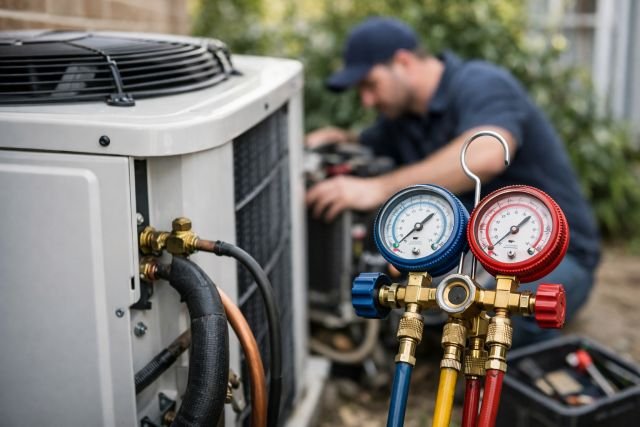
If you’re asking does aircon use gas, you’re not alone — and you’re also probably trying to avoid getting talked into an unnecessary “gas refill.” Here’s the truth: most home air conditioners don’t “use gas” as a fuel the way a car does. They mainly run on electricity, and they circulate a chemical called refrigerant, which is often referred to as “AC gas” in everyday conversation.
- Quick answer: Does aircon use gas?
- “AC gas” explained: Refrigerant isn’t fuel
- When an air conditioner can use natural gas
- How to tell what your aircon actually uses
- Signs your AC is low on refrigerant gas (and what it usually means)
- Before calling a repair guy: 6 checks that can save you money
- The “gas refill” question: Should refrigerant be topped up?
- What a trustworthy AC refrigerant diagnosis looks like
- Refrigerant types you may hear (and why it matters)
- Common scenarios (so you know what’s normal)
- Costs: what you’re really paying for when “AC gas” is involved
- FAQ
- Conclusion: Does aircon use gas — and what should you do next?
That mix-up matters, because it changes what “low gas” really means, how serious it is, and what a trustworthy technician should do when they show up. In this guide, you’ll learn the difference between fuel gas vs refrigerant gas, the most common reasons people think their AC “needs gas,” and what you should check before paying for a repair.
Quick answer: Does aircon use gas?
Most residential air conditioners use electricity to run the compressor and fans. They do not burn gasoline, LPG, or natural gas for cooling the way a stove or a gas heater burns fuel. The “gas” people talk about is usually refrigerant — a substance that changes pressure and state (liquid ↔ gas) to move heat out of your home.
There are a few niche systems that can use natural gas (more on that below), but in typical homes, when someone says “AC gas,” they mean refrigerant.
“AC gas” explained: Refrigerant isn’t fuel
Refrigerant is the working fluid inside your air conditioner. It’s sealed inside copper lines and coils, and it cycles through the system:
- It evaporates (absorbing heat indoors)
- It’s compressed (pressure and temperature rise)
- It condenses (releases heat outdoors)
- It expands again (to repeat the cycle)
That’s why an AC can cool without “creating cold” — it’s moving heat from inside to outside.
The key point homeowners miss
A properly operating AC does not consume refrigerant like a car consumes petrol. So if your unit is “low on gas,” it usually means there’s a leak or a previous improper charge.
And leaks matter for both performance and the environment — many common refrigerants have very high global warming impact.
When an air conditioner can use natural gas
While uncommon for typical houses, some systems can use natural gas (or propane) as an energy source:
1) Gas-fired absorption heat pumps / absorption cooling
These use a heat source (often natural gas) to drive an absorption cycle rather than relying only on an electric compressor. The U.S. Department of Energy notes absorption heat pumps can use natural gas or propane and are generally used in commercial/industrial settings or very large homes.
2) Packaged gas/electric units (more “gas furnace” than “gas AC”)
Some rooftop/package systems include a gas furnace for heating and an electric air conditioner for cooling in one cabinet. People see a gas line and assume cooling uses gas — often it’s just for heating.
Bottom line: for most homes, cooling is electric, and “gas” = refrigerant.
How to tell what your aircon actually uses
A quick reality check before you call anyone:
- Look at the nameplate sticker (outdoor unit or indoor air handler).
You’ll often see refrigerant type like R-410A, R-32, R-22 (older systems). That’s refrigerant “gas,” not fuel. - Check your utility bill pattern
If your cooling costs show up mainly on your electricity usage, your AC is electric-driven (as most are). - If there’s a gas line, trace what it feeds
In many homes, it feeds a furnace or water heater, not the cooling function.
Signs your AC is low on refrigerant gas (and what it usually means)
When refrigerant is low, the system can’t absorb/reject heat properly. Common symptoms include:
- Air feels less cold than usual, even with long runtimes
- Ice on the indoor coil or copper lines (often from low refrigerant or airflow issues)
- Hissing or bubbling sounds (possible leak)
- Higher electricity bills because the system runs longer to hit the set temperature
- Some homes notice humidity feels worse because cooling/dehumidification is reduced
Important: these symptoms can also be caused by dirty filters, clogged coils, weak fans, or duct leaks. So “low gas” is not the only explanation.
Before calling a repair guy: 6 checks that can save you money
You can’t (and shouldn’t) handle refrigerant yourself, but you can eliminate the common “easy stuff” so the visit is more efficient and less scam-prone.
1) Replace or clean the air filter
A clogged filter reduces airflow and can mimic refrigerant problems.
2) Make sure the thermostat is set correctly
Sounds obvious, but wrong mode (fan-only), wrong schedule, or dead batteries can cause “AC not cooling” calls.
3) Check the outdoor unit airflow
Clear leaves, plastic bags, or tight spacing. Poor condenser airflow hurts cooling.
4) Look for ice
If you see icing, turn the cooling off and run the fan to thaw. This reduces the risk of compressor damage, and gives the tech a clearer starting point.
5) Confirm all supply vents are open
Closed vents can create pressure/airflow issues.
6) Note what’s happening (for a better diagnosis)
Tell the technician:
- When the problem started
- Whether cooling is weak all day or only peak afternoon
- Any unusual noises or icing
- Recent repairs (especially “gas refill” history)
The “gas refill” question: Should refrigerant be topped up?
If someone says: “Just top up the gas and you’re good,” that’s a red flag in many cases.
Because refrigerant is sealed, a top-up without identifying why it’s low often means:
- The leak continues
- You’ll be paying again soon
- Performance stays inconsistent
- Environmental impact increases (many refrigerants are potent greenhouse gases)
In regulated contexts, the EPA requires leak repair practices and proper refrigerant management for certain systems. While home rules vary by location, the professional standard is the same: find the leak, fix it, then charge to spec.
What a trustworthy AC refrigerant diagnosis looks like
A solid technician visit typically includes:
- Confirming airflow (filter, blower, coil condition)
- Checking temperatures (return vs supply delta)
- Measuring system pressures and superheat/subcool (depending on system)
- Inspecting for leaks (oil stains at joints, service valves; electronic detection if needed)
- Explaining whether repair is recommended or replacement makes more sense (especially on very old refrigerants)
If the tech can’t explain why refrigerant is low, you’re not getting a real diagnosis.
Refrigerant types you may hear (and why it matters)
- R-22: common in older systems; phased out for new production in many places and typically more expensive to service.
- R-410A: widely used for years; high global warming potential compared to newer options.
- R-32 / newer blends: increasingly used as lower-GWP alternatives in some markets.
If your unit uses an older refrigerant, that can influence repair cost and the “repair vs replace” decision.
Common scenarios (so you know what’s normal)
Scenario A: “My AC was fine, then suddenly not cold.”
This often points to:
- A component failure (capacitor, fan motor)
- A serious leak event
- Or a dirty coil/frozen coil situation
A simple “gas top-up” might temporarily mask the issue if a leak is present.
Scenario B: “They refilled gas last summer, now it’s low again.”
This is a classic sign of:
- A leak that was never fixed
- Or improper charging / poor service practices
Ask for leak testing and documentation of what was done.
Scenario C: “Cooling is okay at night, weak in afternoon.”
This can be:
- Heat load + dirty outdoor coil
- Low refrigerant (sometimes shows more under peak load)
- Undersized unit or duct issues
A good technician will evaluate capacity and airflow — not jump straight to “gas problem.”
Costs: what you’re really paying for when “AC gas” is involved
Prices vary by country and refrigerant type, but your bill usually reflects:
- Service call + diagnostics
- Leak detection time
- Repair labor (brazing, replacing coil, valve cores, etc.)
- Refrigerant cost (varies massively by type and availability)
- Evacuation and proper charging procedures
Tip: ask for the refrigerant type and the amount added (by weight). A professional charge is not “guesswork.”
FAQ
Does aircon use gas or electricity?
Most air conditioners use electricity to run the compressor and fans. The “gas” people mention is typically refrigerant, which circulates inside the system and is not burned as fuel.
Is refrigerant gas the same as LPG or natural gas?
No. Refrigerant is a specialized chemical designed to change state and move heat. LPG/natural gas are fuel gases used for heating/cooking, not for typical electric AC cooling.
If my AC is low on gas, does that mean there’s a leak?
In most cases, yes. Refrigerant doesn’t get “used up.” If it’s low, it usually escaped through a leak or was incorrectly charged before.
Can running the AC with low refrigerant damage the compressor?
It can. Low refrigerant can lead to poor cooling, coil freezing, overheating, and improper compressor operation—especially if left unaddressed.
Do any air conditioners run on natural gas?
Yes, but they’re less common in typical homes. Some absorption heat pumps/coolers can use natural gas or propane as a heat source and are more often used in commercial settings or very large homes.
Conclusion: Does aircon use gas — and what should you do next?
So, does aircon use gas? For most homes, the AC runs on electricity, and the “gas” people talk about is refrigerant—a sealed chemical that should not need topping up unless there’s a problem. If someone recommends a “gas refill” without explaining the cause, push for a proper diagnosis: check airflow, test performance, inspect for leaks, and charge by specification after repairs. Using reputable guidance on refrigerants and leak management helps you avoid repeat costs and protects the system (and the environment) over the long term.