



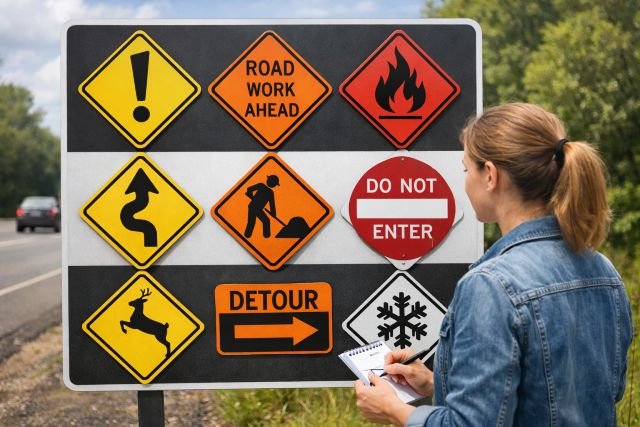
If you’ve ever spotted a diamond shaped sign and felt that tiny “okay… what now?” moment, you’re not alone. Diamond signs are designed to grab attention quickly because they usually signal a warning — something ahead that could require you to slow down, change lanes, or increase awareness.
- What does a diamond shaped sign mean?
- Diamond shaped sign colors and what they signal
- Diamond shaped sign cheat sheet table: meaning, color, action
- Common diamond shaped road signs and how to respond
- When a diamond shape is NOT a normal road warning sign
- Actionable tips to “read” any diamond shaped sign faster
- FAQ: diamond shaped sign quick answers
- Conclusion: using the diamond shaped sign cheat sheet in real life
In the U.S., the clearest “official” clue is the MUTCD (Manual on Uniform Traffic Control Devices), which standardizes how signs look so drivers recognize them fast. For most roads, the MUTCD’s baseline rule is simple: warning signs are diamond-shaped with a black legend and border on a yellow background.
But “diamond-shaped sign” doesn’t always mean just one thing. Color and context matter — and in some cases, diamond-shaped signs are used outside everyday traffic warnings (like hazmat placards on trucks).
What does a diamond shaped sign mean?
In everyday driving, a diamond shaped sign most commonly means Warning: a condition, hazard, or change in the road is ahead and you should adjust your driving. The MUTCD explicitly standardizes the diamond shape for warning signs (with limited exceptions).
Think of it like your road’s “heads-up notification.” It’s not usually telling you a law like a STOP sign does. It’s telling you: “Pay attention — something’s coming.”
Diamond shaped sign colors and what they signal
Yellow diamond shaped sign: general warning (most common)
A yellow diamond shaped sign is the classic “general caution” warning. It can indicate:
- Curves or winding roads ahead
- Intersections, merges, lane drops
- Slippery surfaces, uneven pavement
- Animal crossings, low clearance, and more
What to do: treat yellow diamonds as “prepare to adjust.” Ease off the accelerator, scan further ahead, check mirrors, and be ready to brake or steer smoothly.
The MUTCD’s standard design statement — diamond shape with black legend/border on yellow — backs up why you see this combination so often.
Real-world scenario: You’re on a two-lane road at night and see a yellow diamond with a curved arrow. That sign isn’t asking permission — it’s giving you time to slow down before the curve shows up in your headlights.
Orange diamond shaped sign: work zone / temporary traffic control
An orange diamond shaped sign typically means temporary traffic control — road work, maintenance, utility work, or short-term changes in traffic patterns. Work zone warnings are commonly diamond-shaped with black text/symbols on orange.
What to do: slow down early, expect lane shifts, uneven surfaces, workers/equipment, and sudden stops. Increase following distance and avoid last-second lane changes. Orange signage is where “I’ll figure it out when I get closer” becomes a bad plan.
Real-world scenario: An orange diamond says “FLAGGER AHEAD.” Even if you don’t see anyone yet, assume traffic may stop abruptly around the next bend. Your best move is to reduce speed now and leave room.
Fluorescent yellow-green diamond shaped sign: pedestrians, bikes, school zones
A fluorescent yellow-green diamond shaped sign is used for certain high-priority warnings related to pedestrians, bicyclists, and schools. Many sign guides and MUTCD-aligned references describe this color as reserved for these vulnerable road user contexts.
Why this color? Conspicuity. Research and FHWA materials discuss how fluorescent colors can improve detection/visibility under certain conditions.
What to do: assume people may enter the roadway unexpectedly. Slow down, scan sidewalks and shoulders, and be extra cautious near crosswalks, school entrances, and bike lanes.
Real-world scenario: You see a fluorescent yellow-green pedestrian crossing diamond near dusk. That’s your cue to stop “driving on autopilot,” because someone may step into the crosswalk with limited visibility.
Diamond shaped sign cheat sheet table: meaning, color, action
Here’s the quick-reference version you can mentally pull up in a second.
| Diamond sign color | Typical meaning | What you should do immediately |
|---|---|---|
| Yellow | General warning (road condition/hazard ahead) | Reduce speed if needed, scan ahead, prepare to brake/steer |
| Orange | Work zone / temporary traffic control warning | Slow early, expect pattern changes, increase following distance |
| Fluorescent yellow-green | Pedestrian/bicycle/school-related warning | Heightened awareness, slow down, yield/prepare to stop |
Common diamond shaped road signs and how to respond
Curves, winding roads, and chevrons
A diamond warning sign may show a curve arrow, “Winding Road,” or advisory plaque. Your goal is to enter curves at a safe speed and avoid braking hard mid-turn.
Action tip: brake before the curve, then maintain a steady speed through it. If you’re seeing multiple curve warnings close together, treat it like a “slow zone” until you’re clearly past it.
Merges, lane drops, and shifting lanes
A diamond shaped sign warning of a merge or lane reduction is telling you to plan your lane position early.
Action tip: signal sooner than you think you need to, check blind spots, and merge smoothly. Late merges cause ripple braking and near-misses — especially in work zones.
Intersections and cross traffic
You’ll see diamonds warning of side roads, cross roads, traffic signals ahead, or reduced sight distance.
Action tip: cover the brake and scan left-right-left well before the conflict point.
Surface condition warnings
“Slippery When Wet,” “Bump,” “Dip,” “Uneven Lanes,” and similar warnings are about traction and stability.
Action tip: reduce speed and avoid sudden steering/braking. On wet roads, gentle inputs matter more than you think.
When a diamond shape is NOT a normal road warning sign
This is where people get tripped up: diamond shape can appear in other safety systems.
Diamond hazmat placards on trucks and rail cars
Large diamond-shaped placards on freight vehicles indicate hazardous materials classes. These are governed by hazardous materials regulations (49 CFR) under PHMSA/DOT, not the everyday driver sign system.
What to do as a driver: don’t tailgate or linger next to the vehicle, especially in tunnels or congested areas. If an incident occurs, give extra distance and follow emergency instructions.
If you’re in shipping, transport, or compliance work, PHMSA’s DOT Chart 17 is a widely used reference for placards and markings.
Actionable tips to “read” any diamond shaped sign faster
Use the “SIP” method: Slow, Interpret, Position
When you see a diamond shaped sign, do this in order:
- Slow: reduce speed early (even slightly) to buy decision time.
- Interpret: identify the hazard type (curve? merge? people? work zone?).
- Position: adjust lane position and spacing (more following distance, move away from workers, prepare to yield).
This mental habit is simple, but it’s what keeps warning signs from becoming background decoration.
Treat orange diamonds as a different ruleset
Drivers often underreact to orange because “it’s probably nothing.” But work zones include lane shifts, uneven pavement, and workers close to travel lanes. MUTCD temporary traffic control warnings highlight this environment.
FAQ: diamond shaped sign quick answers
What does a diamond shaped sign mean in driving?
A diamond shaped sign usually means warning—a hazard, road condition, or change in traffic pattern is ahead, and you should adjust speed and attention.
What does a yellow diamond shaped sign mean?
A yellow diamond is a general warning sign (curves, merges, intersections, surface issues). Slow down if needed and prepare to react safely.
What does an orange diamond shaped sign mean?
An orange diamond typically signals a work zone or temporary traffic control warning. Expect lane shifts, workers, and sudden stops; slow down early.
What does a fluorescent yellow-green diamond shaped sign mean?
It usually relates to pedestrian, bicycle, or school warnings. Increase awareness and be ready to yield or stop.
Are hazmat placards diamond-shaped signs too?
Yes — but they’re a different system. Hazmat placards on trucks/rail cars communicate hazardous materials classes and follow DOT/PHMSA rules under 49 CFR.
Conclusion: using the diamond shaped sign cheat sheet in real life
A diamond shaped sign is your early-warning system on the road. Most of the time, it’s telling you to anticipate a hazard and drive proactively — not react at the last second. Remember the color shortcuts: yellow = general warning, orange = work zone change, fluorescent yellow-green = people (pedestrians/bikes/schools), backed by MUTCD-aligned standards and safety guidance.