


If you’re searching for a car odor remover because your AC smells musty, you’re already asking the right question: “How do I stop the smell from coming back?” Spraying perfume-like fresheners into vents can hide the problem for a day or two, but a recurring “damp basement” or “dirty sock” odor usually means there’s moisture + microbial buildup somewhere inside your HVAC system — often on the evaporator core, in the drain area, or trapped in a saturated cabin air filter.
- What causes a musty AC smell in a car?
- Why a “car odor remover” spray alone often fails
- Car odor remover strategy: fix the odor at the source (step-by-step)
- What if the musty smell only happens when the AC first turns on?
- What if the smell is more like “dirty socks,” sour, or rotten?
- When to DIY vs. when to get professional AC odor service
- Mini case scenario: why “one spray” didn’t work
- FAQ: Car odor remover and musty AC smell
- Conclusion: the best car odor remover is the one that removes the source
The good news is that you can usually fix a musty AC smell without replacing major parts — if you treat the source (moisture and biofilm), not just the air. And because musty odors are commonly linked to mold and bacteria, it’s worth taking this seriously for comfort and health. EPA notes that molds can produce allergens and irritants, and exposure can trigger symptoms in sensitive individuals.
In this guide, you’ll learn how musty AC odors start, what a car odor remover can and can’t do, and the most effective, real-world steps to eliminate the smell and keep it from returning — especially in humid weather and stop-and-go driving.
What causes a musty AC smell in a car?
A musty AC smell is typically caused by condensation that doesn’t fully drain or dry, plus organic debris (dust, pollen, tiny leaf fragments). When that damp film sits on surfaces inside the HVAC box — especially the evaporator — microbes can grow and create that mildew-like odor. Automotive HVAC contamination is commonly tied to biofilm growth on the evaporator area because it’s cold and frequently wet.
The top “odor at the source” culprits
Most musty AC complaints trace back to one or more of these:
Evaporator core contamination (the #1 usual suspect).
The evaporator is the cold coil that removes heat from cabin air. Cold metal + humid air = condensation. If the coil stays damp and dirty, odors can develop and get blasted into the cabin when the fan runs.
Cabin air filter holding moisture and microbes.
Cabin filters trap particles, but over time they can become a reservoir of microbial contamination if they’re damp or overdue. Research examining automotive AC filters has found fungi and other microbiological hazards accumulating on used filters.
Clogged or slow evaporator drain.
If condensation can’t drain, water pools — raising humidity inside the HVAC box and feeding odor-causing growth.
A wet interior (mats, carpets, trunk) that recirculates odor.
Even if the HVAC is clean, damp carpet from a leak can keep a “musty” vibe circulating.
If you want the simplest definition for featured snippets:
Definition: A musty AC smell is an odor caused by trapped moisture and microbial growth (mold/mildew/bacteria) in the HVAC system, commonly on the evaporator or in a damp cabin air filter.
Why a “car odor remover” spray alone often fails
A car odor remover is helpful — but only if it’s the right type and used at the right stage.
Many “air fresheners” are fragrance masks, not removers. They add scent molecules on top of odor molecules. In a musty AC situation, the smell returns because:
- The odor source remains (biofilm + damp debris), and
- The fan keeps distributing odor compounds every time the AC runs.
A true car odor remover for this problem does at least one of the following:
- Cleans/removes organic residue from the evaporator/duct surfaces (where odors originate)
- Neutralizes odor compounds (instead of perfuming over them)
- Reduces microbial load in the HVAC box and on the filter (where appropriate)
There’s also a health angle. Mold exposure can cause allergic reactions and irritation in sensitive people, according to EPA and CDC guidance on mold and musty environments.
Car odor remover strategy: fix the odor at the source (step-by-step)
Here’s the approach that tends to work best in real driveways and real shops: start with the filter, then treat moisture, then address the evaporator, then prevent recurrence.
Step 1: Replace the cabin air filter (don’t “save it”)
If your AC smells musty, assume the cabin filter is either:
- loaded with debris,
- damp, or
- both.
Even if it “looks okay,” it can still hold odor. AAA notes that cabin air filters should be replaced on a schedule (varies by vehicle and conditions), and keeping it clean supports better in-car air quality.
Many automakers recommend replacement intervals in the 15,000–30,000 mile range (check your owner’s manual), and musty odor is a common symptom of an overdue filter.
Pro tip: If your vehicle supports it, choose a charcoal/carbon cabin filter. Carbon media can help adsorb some odor-causing gases and improve perceived freshness compared with a basic particulate-only filter.
Step 2: Confirm the AC drain is actually draining
When your AC has been running on a warm day, you should usually see water dripping under the car (normal condensation). No drip doesn’t always mean failure, but it can be a clue — especially if odor is strong and humidity is high.
If the drain is clogged, moisture stays inside the HVAC housing and keeps feeding the smell.
Quick checks:
- Do you get a stronger musty smell right after startup, then it fades? That can suggest overnight moisture.
- Do your windows fog more than usual? That can happen when airflow is restricted or humidity stays high, sometimes tied to filter/drain issues.
If you suspect a clog and you’re not comfortable accessing the drain tube safely, a shop can clear it quickly. It’s often a low-cost fix compared to repeated “spray treatments” that don’t last.
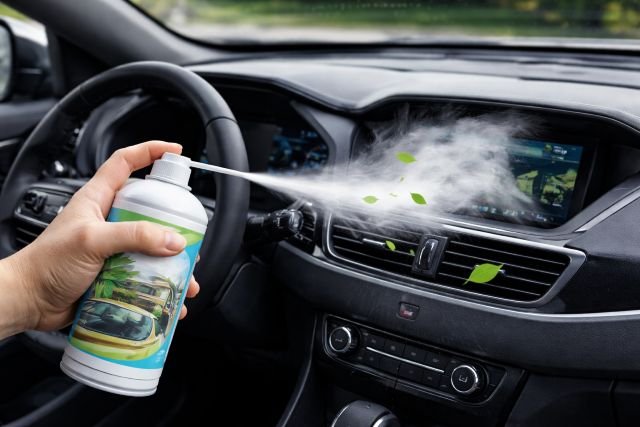
Step 3: Use an HVAC-specific car odor remover that targets the evaporator
This is where most “it came back in 3 days” stories are born: the evaporator still has residue and microbial growth.
For musty AC odor, look for products described as evaporator cleaner, HVAC foam cleaner, or AC system cleaner (not just “new car scent”). The idea is to reach the evaporator surface where growth tends to occur. Technical literature on in-vehicle HVAC contamination often points to evaporator-area biofilms as a root cause of internal air contamination.
How these treatments usually work (in plain English):
- Foam/aerosol is introduced through an intake or drain access.
- It expands, contacts the evaporator fins, loosens residue, and then drains out.
- Some formulations also help reduce microbial load.
A study looking at disinfection approaches in vehicles evaluated microbial contamination before and after disinfection of car AC systems and cabin surfaces, supporting the idea that targeted disinfection can meaningfully reduce contamination.
Important: Follow label instructions carefully, ventilate well, and avoid mixing chemicals. If you have asthma or strong sensitivities, consider having a professional do the evaporator service.
Step 4: Dry out the system after driving (prevention that actually works)
This is the “small habit” that makes a big difference:
Before you park, run the fan with AC off for 1–3 minutes.
This helps dry the evaporator and reduces the damp environment that supports odors. Not every car makes this convenient, but if your car has an “ECON” mode or you can manually turn off the compressor while keeping the fan on, it’s worth doing.
Also, avoid leaving the car on recirculation all the time in humid conditions; fresh air mode can help reduce moisture buildup depending on climate and use.
Step 5: Don’t ignore wet carpets and hidden leaks
If your floor mats feel damp, you may have a separate moisture source (door seals, windshield seal, sunroof drains, heater core leak). A musty interior will keep re-contaminating your HVAC smell — even after you clean it.
CDC’s general mold guidance emphasizes the same core principle: fix the moisture problem or mold/musty odors return.
EPA similarly highlights moisture control as the key to preventing mold.
What if the musty smell only happens when the AC first turns on?
That pattern is classic evaporator moisture sitting overnight. The first blast pushes out the “stale damp air,” and then the smell reduces as airflow changes and surfaces cool.
Best fix: cabin filter + evaporator cleaning + dry-out habit.
What if the smell is more like “dirty socks,” sour, or rotten?
Odor “profiles” aren’t perfect diagnostics, but they help:
- Musty/mildew/damp: moisture + mold/mildew; filter/evaporator/drain.
- Sour/dirty socks: often microbial growth on evaporator surfaces.
- Rotten/egg-like: can sometimes be a different issue (not always HVAC), including external odors entering intake or other vehicle problems — worth a professional inspection if persistent.
When to DIY vs. when to get professional AC odor service
DIY works well when:
- Odor is mild to moderate
- AC performance is otherwise normal
- You can replace the cabin filter and apply a proper evaporator/HVAC cleaner
Professional service is a better call when:
- Odor returns quickly after cleaning (within days)
- You suspect a clogged drain but can’t access it
- There’s visible mold, persistent dampness, or health symptoms
- The blower is weak, AC isn’t cooling well, or you hear water sloshing
Many shops describe musty AC smells as commonly tied to mold, dirty cabin filters, or moisture in the HVAC system, and they often include drain inspection and evaporator cleaning as part of the remedy.
Mini case scenario: why “one spray” didn’t work
Imagine this common situation:
You live in a humid area. Your car sits overnight after a short commute. The evaporator stayed damp, the cabin filter is overdue, and the drain is slow. You spray a vent deodorizer and the car smells better… briefly.
Two days later, the smell returns because:
- The evaporator is still coated with residue (odor source still there)
- The filter still traps moisture and contaminants
- Condensation still isn’t draining efficiently
Now compare that to the “source fix” approach:
- Replace cabin filter (ideally carbon)
- Clear drain (or confirm flow)
- Treat evaporator with an HVAC foam cleaner
- Add a dry-out habit before parking
That’s why some people feel like they’ve tried “everything,” when they really tried masking plus one partial step.
FAQ: Car odor remover and musty AC smell
What is the fastest car odor remover fix for musty AC smell?
The fastest lasting fix is usually: replace the cabin air filter + clean the evaporator. Filters can harbor microbiological contamination over time, and the evaporator is a common source of odor-causing growth.
Why does my car AC smell musty but the car itself doesn’t?
Because the odor can originate inside the HVAC box (evaporator/drain area) even when the seats and carpet are dry. The smell appears mainly when airflow pushes air across contaminated, damp components.
Can a dirty cabin air filter cause a musty smell?
Yes. A dirty or damp cabin air filter can trap organic debris and moisture and become a source of microbial contamination. Studies on automotive AC filters have documented microbiological hazards (including fungi) on used filters.
Is it safe to breathe in musty AC air?
People respond differently, but musty odor often suggests mold/microbial presence. EPA notes molds can cause allergens and irritants and may trigger allergic reactions in sensitive people. If you notice symptoms like coughing, wheezing, or eye irritation, address the source and consider professional help.
How do I stop the smell from coming back?
Prevent recurrence by controlling moisture:
- Keep the cabin air filter on schedule.
- Make sure condensation drains properly.
- Dry out the evaporator (fan-only for a minute or two before parking).
- Fix any interior leaks or damp carpet issues.
Conclusion: the best car odor remover is the one that removes the source
A car odor remover can absolutely help with a musty AC smell — but the real win comes from treating the source: moisture plus microbial buildup on the evaporator, a damp cabin air filter, and any drainage or leak problems that keep the system wet. Replace the cabin filter, confirm the drain works, and use an HVAC/evaporator-focused cleaner rather than a fragrance mask. Then lock in prevention with simple habits that dry the system after you drive.
If you do those steps, you’re not just covering up a smell — you’re fixing why it started, which is what keeps that musty AC odor from becoming a seasonal comeback.