



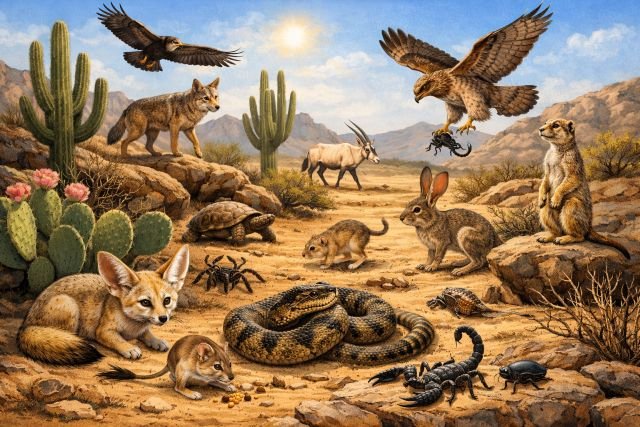
The desert food chain is one of the most fascinating ecological systems on Earth. Despite extreme heat, scarce water, and harsh conditions, deserts support a surprisingly diverse network of plants, animals, and microorganisms that depend on each other for survival. Understanding how this food chain works reveals the remarkable adaptations that allow life to thrive in some of the planet’s most unforgiving environments.
- What Is the Desert Food Chain?
- Producers in the Desert: The Foundation of Life
- Primary Consumers: Herbivores of the Desert
- Secondary Consumers: Small Predators
- Tertiary Consumers: Top Predators
- Decomposers: Recycling Life in the Desert
- Unique Survival Secrets of Desert Life
- Types of Desert Food Chains Around the World
- Desert Food Web vs. Food Chain
- Human Impact on the Desert Food Chain
- Real-World Example: The Sonoran Desert Food Chain
- Actionable Insights: What We Can Learn
- Frequently Asked Questions (FAQs)
- Conclusion
From tiny insects to powerful predators like snakes and hawks, every organism in the desert plays a role in maintaining ecological balance. In this article, we’ll explore the desert food chain in detail, including its key components, unique survival strategies, and real-world examples.
What Is the Desert Food Chain?
The desert food chain refers to the flow of energy from one organism to another within desert ecosystems. It begins with producers (plants) and moves through consumers (herbivores and carnivores) to decomposers.
In simple terms, it shows who eats whom in the desert.
Key Levels of the Desert Food Chain
- Producers: Plants like cacti and shrubs that make their own food using sunlight
- Primary consumers: Herbivores such as insects, rodents, and camels
- Secondary consumers: Small predators like lizards and snakes
- Tertiary consumers: Top predators such as hawks and foxes
- Decomposers: Bacteria and fungi that break down dead matter
According to the National Geographic Society, food chains are essential for understanding energy transfer in ecosystems and how disruptions can impact biodiversity.
Producers in the Desert: The Foundation of Life
Plants form the base of the desert food chain, and their ability to survive with minimal water is extraordinary.
Common Desert Plants
- Cactus (e.g., Saguaro cactus)
- Creosote bush
- Desert grasses
- Mesquite trees
These plants use specialized adaptations such as:
- Water storage in thick stems
- Reduced leaves to minimize water loss
- Deep or widespread root systems
The Saguaro cactus, for example, can store up to 200 gallons of water, making it a critical resource for desert animals.
Why Producers Are Important
Without plants, the desert food chain would collapse. They convert sunlight into energy through photosynthesis, supporting all other life forms.
Primary Consumers: Herbivores of the Desert
Primary consumers feed directly on plants and are essential for transferring energy up the food chain.
Examples of Desert Herbivores
- Grasshoppers
- Kangaroo rats
- Camels
- Desert tortoises
Kangaroo rats are particularly interesting because they can survive without drinking water. They obtain moisture from seeds and produce highly concentrated urine to conserve water.
Adaptations for Survival
- Nocturnal behavior to avoid heat
- Efficient water usage
- Burrowing to stay cool
Research from the U.S. Geological Survey highlights that many desert animals are active at night to reduce water loss and overheating.
Secondary Consumers: Small Predators
Secondary consumers eat herbivores and play a key role in controlling population levels.
Examples
- Lizards
- Snakes
- Scorpions
Lizards, for instance, feed on insects and small rodents, helping maintain balance in the desert ecosystem.
Survival Strategies
- Camouflage to avoid predators
- Heat tolerance
- Venom (in some species like scorpions)
Scorpions can slow their metabolism dramatically, allowing them to survive long periods without food.
Tertiary Consumers: Top Predators
At the top of the desert food chain are apex predators.
Examples
- Hawks
- Eagles
- Foxes (e.g., Fennec fox)
- Coyotes
These animals have few natural predators and rely on hunting skills to survive.
Example Food Chain
Plant → Grasshopper → Lizard → Snake → Hawk
This chain illustrates how energy flows upward, with each level depending on the one below.
Decomposers: Recycling Life in the Desert
Decomposers break down dead plants and animals, returning nutrients to the soil.
Examples
- Bacteria
- Fungi
- Beetles
Even in dry conditions, decomposition occurs, although at a slower rate compared to wetter ecosystems.
Why They Matter
Decomposers ensure that nutrients are recycled, allowing plants to grow and continue the desert food chain.
Unique Survival Secrets of Desert Life
One of the most remarkable aspects of the desert food chain is how organisms adapt to extreme conditions.
Water Conservation
- Animals like camels store fat in humps, which can be converted into water
- Kangaroo rats rarely drink water
Temperature Regulation
- Many animals are nocturnal
- Some reptiles bask in the sun to regulate body temperature
Camouflage and Defense
- Sand-colored fur or scales help animals blend in
- Venom and toxins provide protection
According to the World Wildlife Fund (WWF), desert species have evolved over millions of years to survive temperature extremes that can exceed 50°C.
Types of Desert Food Chains Around the World
Different deserts have slightly different food chains depending on climate and geography.
Hot Deserts (e.g., Sahara)
- Dominated by reptiles, insects, and hardy mammals
Cold Deserts (e.g., Gobi)
- Include animals like snow leopards and wild camels
Coastal Deserts
- Feature unique species adapted to fog-based moisture
Each variation demonstrates how ecosystems adapt to local conditions.
Desert Food Web vs. Food Chain
While a food chain shows a single pathway, a food web is more complex.
Key Difference
- Food chain: Linear sequence
- Food web: Interconnected network
In reality, desert ecosystems function as food webs, with animals having multiple food sources.
Human Impact on the Desert Food Chain
Human activities are increasingly affecting desert ecosystems.
Major Threats
- Climate change
- Habitat destruction
- Overgrazing
- Pollution
A study published by the United Nations Environment Programme (UNEP) warns that desertification affects over 2 billion people globally.
Consequences
- Disrupted food chains
- Loss of biodiversity
- Increased vulnerability of species
Real-World Example: The Sonoran Desert Food Chain
The Sonoran Desert in North America is one of the most studied desert ecosystems.
Key Players
- Producers: Saguaro cactus
- Herbivores: Desert rodents
- Predators: Rattlesnakes, hawks
This ecosystem demonstrates how even small changes can impact the entire food chain.
Actionable Insights: What We Can Learn
Understanding the desert food chain offers valuable lessons:
- Adaptability is key to survival
- Resource efficiency is critical
- Balance in ecosystems must be maintained
These principles can even inspire sustainable living practices in human societies.
Frequently Asked Questions (FAQs)
What is the desert food chain in simple terms?
The desert food chain is the sequence of organisms where each one feeds on the previous, transferring energy from plants to top predators.
What are producers in the desert?
Producers are plants like cacti and shrubs that make their own food using sunlight.
How do animals survive in deserts?
They use adaptations such as water conservation, nocturnal behavior, and heat resistance.
What is an example of a desert food chain?
Cactus → Insect → Lizard → Snake → Hawk
Why is the desert food chain important?
It maintains ecological balance and ensures energy flow within the ecosystem.
Conclusion
The desert food chain is a powerful example of nature’s resilience and adaptability. Despite extreme conditions, a complex network of plants, animals, and decomposers works together to sustain life. From water-storing cacti to nocturnal predators, every organism plays a vital role in maintaining balance.
By understanding the desert food chain, we not only gain insight into ecological systems but also learn valuable lessons about survival, efficiency, and sustainability. Protecting these fragile ecosystems is essential for preserving biodiversity and ensuring that life continues to thrive in even the harshest environments on Earth.