



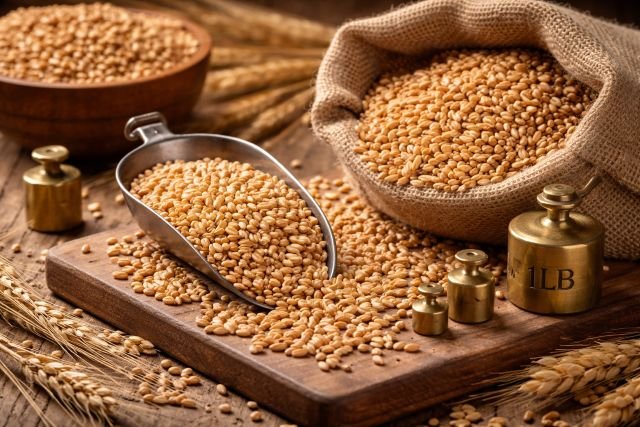
If you’ve ever asked how many grains in a pound, you’re not alone. This question often comes up in fields like firearms, pharmaceuticals, jewelry, and even historical measurements. The answer is simple yet surprisingly important:
- What Is a Grain? Understanding the Smallest Unit
- How Many Grains in a Pound? Exact Conversion Explained
- Why Use Grains Instead of Grams or Ounces?
- Historical Background of the Grain Measurement
- Practical Uses: Where You’ll See Grains Today
- Converting Grains to Other Units
- Real-World Example: Why Accuracy Matters
- Grains vs Metric System: Which Is Better?
- Common Misconceptions About Grains and Pounds
- FAQ: How Many Grains in a Pound?
- Expert Tips for Using Grain Measurements
- Conclusion: Mastering How Many Grains in a Pound
There are exactly 7,000 grains in one pound.
This precise conversion is part of the avoirdupois system, which is the standard weight system used in the United States and many other countries today. Understanding this relationship can help you make accurate calculations, especially in technical or specialized contexts.
In this guide, you’ll learn not just the answer, but also the history behind grains, why this unit still matters, and how to use it in real-life situations.
What Is a Grain? Understanding the Smallest Unit
Before diving deeper into how many grains in a pound, it’s important to understand what a grain actually is.
A grain is one of the oldest units of mass still in use today. Historically, it was based on the weight of a single grain of barley or wheat. Over time, it became standardized.
Today, one grain is officially defined as:
1 grain = 0.06479891 grams
This makes it an extremely small unit of measurement. Because of its precision, it’s still widely used in areas where even tiny differences matter.
How Many Grains in a Pound? Exact Conversion Explained
Let’s break it down clearly.
The standard conversion is:
1 pound (lb) = 7,000 grains (gr)
This is based on the avoirdupois system, which is the most commonly used system for measuring weight in everyday life.
To understand this better:
- 1 pound = 16 ounces
- 1 ounce = 437.5 grains
- Therefore: 16 × 437.5 = 7,000 grains
This exact number is fixed and universally accepted.
Why Use Grains Instead of Grams or Ounces?
You might wonder why grains are still used when grams and ounces are more common.
The answer lies in precision and tradition.
Grains are especially useful when measuring very small weights. For example, in ammunition, even a difference of a few grains can significantly affect performance. Similarly, in medicine, dosage accuracy can be critical.
Because of this, grains remain relevant despite the widespread adoption of the metric system.
Historical Background of the Grain Measurement
The grain has a fascinating history that dates back thousands of years.
Ancient civilizations used seeds as a natural standard for weight. Since grains like barley were relatively uniform in size, they became a convenient reference.
According to historical records, the grain was standardized in England during the medieval period. It later became part of the British Imperial system, which influenced modern measurement systems.
This long history explains why the grain is still embedded in modern measurement systems.
Practical Uses: Where You’ll See Grains Today
Understanding how many grains in a pound becomes especially useful when you encounter real-world applications.
Ammunition and Ballistics
One of the most common uses of grains is in measuring bullet weight. Ammunition is typically labeled in grains rather than grams.
For example, a “55-grain bullet” means the projectile weighs 55 grains. Even small variations can affect velocity and impact.
Pharmaceuticals
In medicine, grains were historically used to measure drug dosages. While modern systems use milligrams, grains still appear in some contexts.
For example, aspirin used to be commonly labeled in grains.
Jewelry and Precious Metals
Grains are also used in weighing small amounts of gold and gemstones. Precision is key in these industries, making grains a useful unit.
Converting Grains to Other Units
Knowing how many grains in a pound is helpful, but you may also need to convert grains into other units.
Here are some useful conversions explained in simple terms.
One grain equals approximately 0.065 grams. So if you have 100 grains, that’s about 6.48 grams.
Similarly, since there are 7,000 grains in a pound, dividing grains by 7,000 will give you the weight in pounds.
For example:
If you have 3,500 grains, that equals 0.5 pounds.
These conversions are especially useful in technical fields where precision matters.
Real-World Example: Why Accuracy Matters
Imagine you’re reloading ammunition.
A difference of just 10 grains in powder weight can significantly change the pressure inside a firearm. This can affect both performance and safety.
Similarly, in pharmaceuticals, even a small miscalculation could lead to incorrect dosing.
This is why understanding exact conversions like how many grains in a pound is more than just academic—it has real consequences.
Grains vs Metric System: Which Is Better?
The metric system is widely considered more straightforward because it uses base-10 conversions. However, grains still have advantages in niche applications.
Grains offer extremely fine measurement without requiring decimals. This makes them practical in fields that demand precision.
That said, most scientific work today uses grams and milligrams for consistency and global standardization.
The metric system remains the global standard, but traditional units like grains persist due to their specialized usefulness.
Common Misconceptions About Grains and Pounds
Many people assume grains are related to food grains like rice or wheat. While the term originated from that idea, it is now a standardized unit.
Another misconception is that grains vary by system. In reality, the grain is consistent across measurement systems, unlike pounds, which can differ slightly.
Understanding these distinctions helps avoid confusion when dealing with conversions.
FAQ: How Many Grains in a Pound?
How many grains are in 1 pound exactly?
There are exactly 7,000 grains in one pound.
Why is a pound equal to 7,000 grains?
This comes from the avoirdupois system, where 1 pound equals 16 ounces and each ounce equals 437.5 grains.
Are grains still used today?
Yes, grains are commonly used in ammunition, pharmaceuticals, and jewelry due to their precision.
How do I convert grains to pounds?
Divide the number of grains by 7,000 to get the weight in pounds.
Is a grain the same worldwide?
Yes, one grain is universally defined as approximately 0.0648 grams.
Expert Tips for Using Grain Measurements
When working with grains, always use precise tools like digital scales. Even small errors can lead to significant differences in results.
It’s also helpful to memorize key conversions, especially if you work in a field where grains are frequently used.
Finally, double-check calculations when converting between units. Accuracy is critical in technical applications.
Conclusion: Mastering How Many Grains in a Pound
By now, you should have a clear understanding of how many grains in a pound and why this measurement matters.
To recap, there are exactly 7,000 grains in one pound, a standard that has stood the test of time. Whether you’re working with ammunition, medicine, or precious metals, this conversion is essential for accuracy.
Grains may seem like an outdated unit, but their precision ensures they remain relevant today. By understanding their role and how to convert them, you gain a valuable skill that applies across multiple industries.