



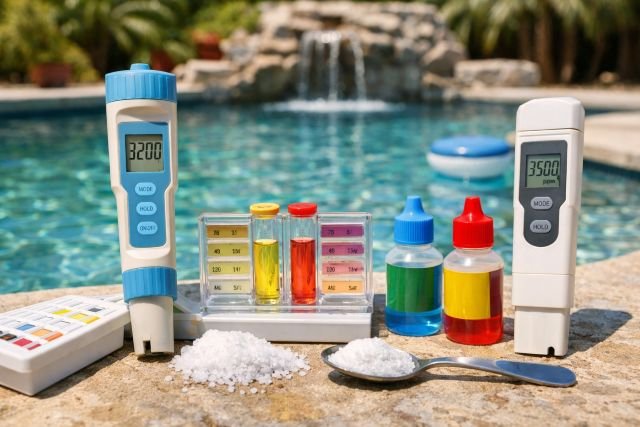
Maintaining a saltwater swimming pool requires accurate water chemistry monitoring, and a pool test kit for saltwater pool systems is one of the most essential tools you can own. While saltwater pools are often marketed as “low maintenance,” the truth is that they still require regular testing of chlorine, pH, alkalinity, and salinity levels.
- Why You Need a Pool Test Kit for Saltwater Pool Maintenance
- Key Features to Look for in a Saltwater Pool Test Kit
- Types of Pool Test Kits for Saltwater Pools
- Best Pool Test Kit for Saltwater Pool Systems
- How Often Should You Test a Saltwater Pool?
- How to Use a Pool Test Kit for Saltwater Pool Systems
- Ideal Water Chemistry Levels for Saltwater Pools
- Common Saltwater Pool Testing Mistakes
- Expert Tips for Crystal Clear Saltwater Pool Water
- Frequently Asked Questions
- Conclusion
Without proper testing, your saltwater generator can produce too much or too little chlorine, leading to cloudy water, algae growth, or even equipment damage. Using the right saltwater pool test kit ensures that your water stays balanced, safe for swimmers, and sparkling clear.
In this comprehensive guide, we’ll explore how saltwater pool testing works, what features to look for in a testing kit, and the top pool test kits for saltwater pools that deliver reliable results.
Why You Need a Pool Test Kit for Saltwater Pool Maintenance
Saltwater pools operate differently from traditional chlorine pools. Instead of adding chlorine manually, a salt chlorine generator (SWG) converts salt in the water into chlorine through electrolysis.
However, the process depends on balanced chemistry. According to the Centers for Disease Control and Prevention (CDC), maintaining proper disinfectant levels is essential to prevent harmful microorganisms in pool water.
A reliable pool test kit for saltwater pool systems helps you monitor critical parameters including:
Salt levels (salinity)
Free chlorine and total chlorine
pH balance
Total alkalinity
Calcium hardness
Stabilizer (cyanuric acid)
If these levels drift out of range, the salt cell may stop generating chlorine efficiently, leading to sanitation problems.
Regular testing helps you avoid issues such as:
Cloudy or green water
Salt cell scaling
Corrosion of pool equipment
Skin and eye irritation for swimmers
With accurate testing, you can quickly adjust chemicals before problems escalate.
Key Features to Look for in a Saltwater Pool Test Kit
Not all test kits are designed for saltwater pools. Because salinity affects chlorine production, specialized testing capabilities are important.
When choosing a saltwater pool testing kit, consider the following features.
Accurate Salinity Measurement
Saltwater pools typically operate best between 2700–3400 ppm salt concentration depending on the generator model.
A good test kit should either include a salinity test strip, drop test, or digital meter capable of measuring salt levels accurately.
Comprehensive Water Chemistry Testing
The best pool test kits measure multiple parameters, including chlorine, pH, alkalinity, and calcium hardness.
These values determine how effectively the salt generator produces chlorine.
Easy-to-Read Results
Digital meters and color comparator kits provide clear readings. Test strips are convenient but can be less precise.
Durability and Cost Efficiency
Liquid reagent kits last longer and provide higher accuracy, while strips offer speed and convenience.
Pool professionals often recommend drop-based kits for serious maintenance.
Types of Pool Test Kits for Saltwater Pools
Understanding the different testing methods can help you choose the right option.
Test Strips
Test strips are the quickest and easiest method. You simply dip the strip into pool water and compare the color results.
They typically test for:
Chlorine
pH
Alkalinity
Cyanuric acid
Salt levels
While convenient, strips can sometimes produce inconsistent readings.
Liquid Test Kits
Liquid reagent kits use chemical drops to analyze water samples. They provide more precise results compared to strips.
Pool professionals often rely on these kits for weekly testing.
Digital Pool Water Testers
Digital testers measure water chemistry electronically and display results instantly.
Some advanced models connect to mobile apps for water tracking and maintenance reminders.
Best Pool Test Kit for Saltwater Pool Systems
Below are some of the most reliable test kits used by pool owners and professionals.
Taylor K-2006 Saltwater Pool Test Kit
The Taylor K-2006 is widely considered one of the most accurate professional testing kits available.
It uses the FAS-DPD chlorine testing method, which provides extremely precise readings of free and combined chlorine.
Advantages include:
Professional-level accuracy
Tests multiple water parameters
Long-lasting reagents
This kit is commonly used by pool service technicians because it delivers laboratory-level precision.
LaMotte ColorQ Pro 11 Digital Pool Tester
The ColorQ Pro 11 offers digital testing that eliminates guesswork when interpreting colors.
It measures eleven different water chemistry parameters including salt levels, making it ideal for saltwater pools.
Key benefits include:
Digital readings
Quick testing process
Highly accurate sensors
Because results appear on a screen, this tester is especially helpful for beginners.
AquaChek Saltwater Pool Test Strips
For homeowners looking for convenience, AquaChek strips provide fast and affordable testing.
These strips specifically measure:
Salt levels
Free chlorine
pH
Total alkalinity
Stabilizer
They’re widely used for routine weekly checks.
Poolmaster 5-Way Test Kit
This kit provides basic but reliable testing using liquid reagents.
It measures chlorine, pH, alkalinity, acid demand, and bromine levels.
Although it does not directly test salinity, it works well alongside separate salt strips.
How Often Should You Test a Saltwater Pool?
Regular testing keeps your saltwater pool healthy and prevents expensive problems.
Most pool experts recommend the following schedule:
Test chlorine and pH two to three times per week
Check salinity once every two weeks
Test alkalinity and calcium hardness monthly
According to the Pool & Hot Tub Alliance, consistent water testing is one of the most effective ways to maintain safe swimming conditions.
During hot weather or heavy pool usage, testing may be required more frequently.
How to Use a Pool Test Kit for Saltwater Pool Systems
Testing your pool water properly ensures accurate results.
Start by collecting water samples from about 18 inches below the surface, away from return jets or skimmers.
Follow the instructions specific to your test kit. For liquid kits, add reagents drop by drop and observe color changes.
Compare the results to the chart included with the kit.
If the results fall outside the recommended ranges, adjust chemicals gradually and retest after circulation.
Ideal Water Chemistry Levels for Saltwater Pools
Keeping water balanced ensures your salt generator works efficiently.
Recommended ranges include:
Free chlorine: 1–3 ppm
pH: 7.2–7.6
Total alkalinity: 80–120 ppm
Calcium hardness: 200–400 ppm
Salt: 2700–3400 ppm
Balanced water not only keeps swimmers comfortable but also extends the lifespan of pool equipment.
Common Saltwater Pool Testing Mistakes
Many pool owners unknowingly make mistakes that affect testing accuracy.
One common issue is testing water immediately after adding chemicals. This can lead to misleading results.
Another mistake is storing reagents in hot environments. Heat can degrade chemicals and reduce accuracy.
Expired test strips or reagents can also produce unreliable readings.
For best results, always store test kits in a cool, dry location and replace reagents annually.
Expert Tips for Crystal Clear Saltwater Pool Water
Maintaining perfect water clarity involves more than just testing.
Regular brushing and filtration help remove debris and prevent algae growth.
Cleaning the salt cell periodically prevents mineral buildup that can reduce chlorine production.
Monitoring stabilizer levels ensures chlorine remains effective under sunlight.
Many professional pool technicians recommend maintaining slightly higher cyanuric acid levels in saltwater pools to protect chlorine from UV degradation.
Frequently Asked Questions
What is the best pool test kit for saltwater pool owners?
The Taylor K-2006 and LaMotte ColorQ Pro 11 are among the most accurate and reliable kits for saltwater pool testing.
Can regular pool test kits be used for saltwater pools?
Yes, but they may not measure salinity. A pool test kit for saltwater pool systems should ideally include salt level testing.
How often should salt levels be tested?
Salt levels should be tested at least every two weeks or whenever water is added to the pool.
Are digital pool testers more accurate?
Digital testers reduce human interpretation errors, but high-quality liquid kits can be equally accurate when used properly.
Conclusion
A reliable pool test kit for saltwater pool maintenance is essential for keeping water clean, safe, and properly balanced. Regular testing allows you to monitor chlorine production, salinity, and overall water chemistry before problems arise.
Whether you choose professional liquid kits, convenient test strips, or advanced digital testers, consistent testing will ensure your saltwater pool stays sparkling clear throughout the swimming season.
Investing in the right pool test kit for saltwater pool systems not only improves water quality but also protects your equipment, reduces chemical waste, and creates a healthier swimming environment for everyone.