



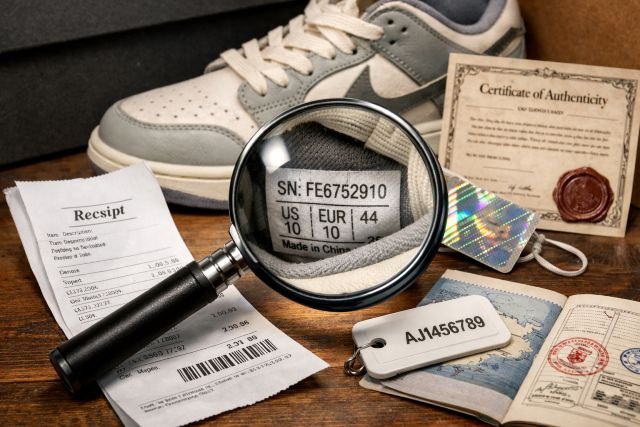
Buying premium footwear online should feel exciting, not stressful. Yet counterfeit shoes have become so convincing that even experienced collectors sometimes get fooled. That’s why bestshoesevershop product authenticity isn’t just a marketing phrase — it’s a process built on verifiable documentation, traceable identifiers, and clear proof of origin.
- Why authenticity documentation matters more than “looks legit”
- What “bestshoesevershop product authenticity” should mean in practice
- Receipts and invoices: what they prove (and what they don’t)
- Serial numbers, SKU/style codes, and box labels: the authenticity “triangle”
- Proof of origin: the evidence counterfeiters struggle to replicate end-to-end
- A practical bestshoesevershop product authenticity workflow (before and after delivery)
- Real-world scenarios: how authenticity evidence saves you
- Common red flags that receipts and serial numbers expose quickly
- Featured snippet definition: What is proof of origin for shoes?
- FAQs about bestshoesevershop product authenticity
- Conclusion: building trust with bestshoesevershop product authenticity
In this guide, you’ll learn how authenticity evidence actually works (and where it often fails), what receipts and serial numbers can prove, and how to build a “paper trail” you can rely on — whether you’re buying a daily-wear pair or a high-demand drop.
Why authenticity documentation matters more than “looks legit”
Modern fakes aren’t just sloppy replicas anymore. Counterfeit supply chains have professionalized, and the volume is large enough that major marketplaces publish recurring trust reports. For example, StockX said it rejected more than 370,000 products in 2024 that didn’t meet verification standards, valued at nearly $74 million.
Zooming out even further, the OECD reported counterfeit goods accounted for an estimated USD 467 billion in global trade in 2021 (latest available data referenced in their 2025 release).
So the goal isn’t only to “spot flaws.” The goal is to confirm a believable chain of custody—starting with documents and identifiers that are hard to fake consistently.
What “bestshoesevershop product authenticity” should mean in practice
When a store claims authenticity, the strongest version of that claim is not a vibe. It’s evidence:
A real authenticity process typically includes:
- Proof of purchase (receipt/invoice + merchant details)
- Product identifiers (SKU/style code, UPC/EAN, box label data, and brand-specific tag details)
- Proof of origin (where it came from, through whom, and in what condition)
- Consistency checks across all three (documents match the physical item and packaging)
If any of those pillars is missing, authenticity becomes “probable,” not “provable.”
Receipts and invoices: what they prove (and what they don’t)
Receipts are powerful because they can establish a purchase event — but they do not automatically prove the shoes in your hand are the same shoes on that receipt.
What a receipt can reliably prove
A strong receipt or invoice typically proves:
- The retailer existed and sold the model on a specific date
- The method of purchase (online, in-store) and payment confirmation
- Sometimes: SKU/style code, size, color, and price
That last part — SKU and product details — is critical, because it creates a bridge between the transaction and the item identity.
What a receipt cannot prove by itself
Receipts don’t prove that:
- The seller didn’t swap pairs after purchase
- The shoes weren’t returned and replaced
- The invoice wasn’t edited (yes, that happens)
Actionable tip: Treat receipts as necessary but not sufficient. You want the receipt to match the serial/SKU information on the shoe and the box label.
Best practice: “receipt quality checklist”
A high-trust proof-of-purchase usually includes:
- Full merchant name + contact details
- Order number + date/time
- Line item with SKU/style code and size
- Payment confirmation (last 4 digits, transaction ID, or a matching payment reference)
If your order confirmation email and your invoice disagree on SKU or size, treat it as a red flag and pause before “accepting” authenticity.
Serial numbers, SKU/style codes, and box labels: the authenticity “triangle”
Most buyers say “serial number,” but what they often mean is a set of identifiers that must agree with each other.
SKU/style code (the most useful identifier)
For many Nike/Jordan products, the style code is commonly formatted like NNNNNN-NNN, and a standard legit check is ensuring the style code on the inner tag matches the box label.
That match isn’t perfect proof (labels can be copied), but mismatches are a strong indicator something is off.
UPC/EAN barcode (helpful, but easy to misuse)
A barcode can confirm the product category and sometimes the intended market, but counterfeiters can print a “valid-looking” barcode too. Barcode scanning is best treated as a consistency check, not a final verdict.
Brand-specific serial behavior (example: Adidas)
Adidas pairs are frequently discussed in terms of serial numbers and internal tags. Many guides emphasize checking tag formatting and consistency with box/product information.
Important nuance: Some “serial number rules” floating online are model- or era-specific. Don’t rely on a single internet rule (like “left and right must always differ”) unless it’s supported for that exact product line.
Proof of origin: the evidence counterfeiters struggle to replicate end-to-end
If receipts are about the purchase, proof of origin is about the chain of custody.
What counts as proof of origin?
Depending on your business model, proof of origin can include:
- Authorized retailer or distributor invoice trail
- Purchase confirmation from a verified marketplace plus authentication outcome documentation
- Batch/lot references (where available) and consistent inbound records
- Shipping records that align with the purchase channel
Why this matters: counterfeit networks thrive in channels with weak enforcement. The USTR’s “Notorious Markets” reporting repeatedly highlights that counterfeit apparel and footwear remain prevalent on certain platforms and markets, even as some increase anti-counterfeit investment.
What “proof of origin” looks like for a customer
Customers rarely see distributor paperwork, but they can receive:
- A detailed invoice (not just a payment receipt)
- A verification statement describing what was checked (identifiers + packaging + construction markers)
- Clear return/refund terms tied to authenticity disputes
A practical bestshoesevershop product authenticity workflow (before and after delivery)
Here’s a workflow that’s easy for customers to follow and also reduces disputes.
Before buying: “evidence-first” questions
Ask (or publish answers to) these:
- Will I receive a detailed invoice showing SKU/style code and size?
- Do you provide proof-of-origin documentation or a verification statement?
- What happens if the SKU on the box doesn’t match the tag?
- What is the process timeline for authenticity claims?
When those answers are public, buyers trust you more — and scammers have a harder time exploiting ambiguity.
On delivery: the 10-minute verification routine
Encourage customers to do this immediately, ideally while filming a quick unboxing video (useful for disputes).
- Match order invoice SKU to box label SKU
- Match box label SKU to inner size tag SKU (especially Nike/Jordan)
- Photograph the size tag and box label clearly
- Check packaging quality (print clarity, spacing, label placement consistency)
- If anything mismatches, stop wearing the shoes and contact support immediately
This routine catches the most common “document mismatch” issues early, before a pair gets worn (which complicates returns).
Real-world scenarios: how authenticity evidence saves you
Scenario 1: The “perfect-looking” pair with the wrong code
A buyer receives shoes that look flawless — stitching, shape, even smell. But the inner tag style code differs by one digit from the box label.
That’s often enough to treat the pair as non-authentic until proven otherwise, because legitimate production and packaging systems are designed to keep those identifiers consistent.
Scenario 2: The receipt is real, the shoes are not
This happens when someone buys an authentic pair, keeps the receipt, and later sells a counterfeit pair using that receipt as “proof.”
Your defense is not arguing about the receipt — it’s requiring identifier consistency and proof-of-origin records that connect the transaction to the item.
Scenario 3: Independent authentication as a tie-breaker
If a customer remains uncertain, third-party authentication services exist and commonly issue digital certificates after reviewing photos.
Even then, emphasize that the best outcome is consistent evidence across documents + identifiers + construction, not a single screenshot or opinion.
Common red flags that receipts and serial numbers expose quickly
Counterfeits often fail on consistency:
- Invoice shows one SKU, box label shows another
- Size tag typography looks blurry or poorly aligned
- Box label spacing or font weight looks “off” compared to known retail pairs
- The seller refuses to provide an invoice that includes SKU/style code
- The story of origin is vague (“from a friend,” “factory extra,” “no box but 100% legit”)
Also remember: enforcement agencies document cases where counterfeit footwear operations add branding to non-authentic base products, which is another reason “looks right” is not enough.
Featured snippet definition: What is proof of origin for shoes?
Proof of origin for shoes is documentation and traceable evidence showing where a pair came from (retailer/distributor/marketplace), when it was acquired, and how its identifiers (SKU, box label, tags) match that purchase trail.
FAQs about bestshoesevershop product authenticity
Do receipts guarantee authenticity?
No. Receipts prove a purchase happened, but they don’t prove the shoes you received are the exact shoes from that purchase. Use receipts together with SKU/serial consistency and proof of origin.
Where do I find the SKU or style code?
Usually on the inner tongue/lining size tag and on the box label. For Nike/Jordan, a common check is that the style code on the inner tag matches the box label.
Can I authenticate shoes by scanning the barcode?
Barcode scans can help verify that the label data is plausible, but barcodes can be copied. Use barcode scanning only as a supporting check.
What if the SKU matches but I’m still unsure?
Use a layered approach: compare construction details, packaging quality, and request proof-of-origin documentation. If doubt remains, consider third-party authentication services that provide a certificate after review.
Why is counterfeit risk so high right now?
Global supply chains and online marketplaces make it easier for counterfeits to move quickly. Major reports show the scale is significant — OECD estimated USD 467B in counterfeit goods in global trade (2021 data), and resale marketplaces report rejecting large volumes of suspect goods.
Conclusion: building trust with bestshoesevershop product authenticity
At the end of the day, bestshoesevershop product authenticity should be something customers can verify, not just something they’re told. Receipts help establish purchase history, serial/SKU identifiers help confirm product identity, and proof of origin ties everything together into a chain of custody that’s difficult to fake consistently.
If you’re a buyer, your smartest move is to check for consistency across the invoice, the box label, and the inner tag, and to keep clear photos from day one. If you’re a seller, the fastest path to trust is simple: provide stronger documentation, explain your verification steps transparently, and make your proof-of-origin policy easy to find.