


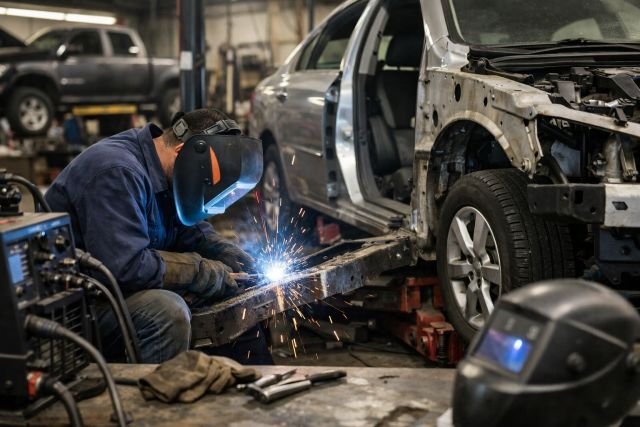
Searching for a car welding shop near me usually means you need a repair that’s more serious than a paint scuff — something structural, something rusty, or something that’s starting to crack, flex, or make the car feel “off.” The good news is that frame and body welding can be done affordably when the shop diagnoses correctly, follows OEM procedures, and uses the right welding method for your vehicle’s materials.
- What a “car welding shop” actually does (and why it matters)
- Car welding shop near me — common repairs and typical price drivers
- Average cost expectations (what most estimates include)
- Why OEM procedures matter (and how to verify a shop follows them)
- Welding methods you’ll hear about (and what they mean)
- How to choose a truly affordable local shop (without gambling on safety)
- FAQ
- Conclusion: finding the right car welding shop near me
The tricky part is that “welding” isn’t one-size-fits-all anymore. Modern vehicles use a mix of high-strength steels, ultra-high-strength steels, aluminum, and adhesives — so the correct attachment method matters for safety and durability. That’s why learning how to evaluate a local shop (and your estimate) can save you money and keep your car safe.
If you’re comparing shops right now, this guide walks you through pricing expectations, repair types, what to ask, and how to spot shortcuts before they become expensive problems.
What a “car welding shop” actually does (and why it matters)
A car welding shop near me may be an auto body shop, a frame shop, a restoration shop, or a fabrication shop. What matters is whether they’re equipped and trained for automotive structural repair, not just general metal fabrication.
Today’s collision repairs often require mixed attachment methods — for example, a repair area might call for spot welding in one location, MIG welding in another, and MIG brazing elsewhere. Industry training organizations emphasize that OEM procedures are the blueprint, because vehicle construction and required attachment methods vary widely.
A quality automotive welding shop typically handles:
- Frame sectioning or rail repairs (where permitted by OEM procedure)
- Unibody structural welding (rockers, pillars, rails, aprons)
- Rust cut-out and patch panels
- Exhaust welding (non-structural, usually cheaper)
- Bracket and mount repair (when safe and appropriate)
- Body panel replacement and welding/bonding
When a shop says, “We can weld anything,” your next question should be: “Do you follow OEM repair procedures for my exact make/model?” Organizations like I-CAR maintain guidance on accessing OEM repair information, because that’s where the correct methods, order of operations, and safety steps are defined.
Car welding shop near me — common repairs and typical price drivers
Prices vary by city, vehicle type, and how much disassembly is required, but the biggest cost drivers are usually:
- Is it structural or cosmetic?
Structural welding (rails, pillars, suspension mounting areas) demands tighter standards, more measurement work, and more liability. - Is the metal high-strength or ultra-high-strength steel?
Some areas can’t be heat-straightened or welded “the old way” without compromising strength. OEM procedures decide what’s repairable vs. replace-only. - Do you need measuring and pulling before welding?
Frame damage often isn’t “just a crack.” A good shop measures the structure, corrects alignment, then performs welding or sectioning as required. - Do you need scanning and calibration?
Even “metal” repairs can trigger diagnostic steps and ADAS calibration. Repair complexity has pushed collision repair costs higher, with industry reporting that recalibration is increasingly common and adds cost.
A quick reality check on “affordable”
Affordable doesn’t always mean “cheapest.” It means the repair is right the first time, documented, corrosion-protected, and aligned to OEM standards — so you don’t pay twice.
Average cost expectations (what most estimates include)
Because welding jobs range from small rust patches to major structural repairs, online “average cost” numbers can be noisy. Instead, use these practical anchors:
- For local pricing baselines, consumer tools like RepairPal provide location-based estimates and a way to compare “fair price” ranges in your area.
- AAA’s repair estimate tool can also help you sanity-check labor and parts categories.
- For collision-related work, industry reporting has shown the average insurance claim repair cost has climbed in recent years, reflecting modern vehicle complexity (diagnostics, sensors, materials, and procedures).
What to look for in a welding estimate
A solid estimate usually explains:
- What part is being repaired (and whether it’s structural)
- The attachment method (spot weld, MIG, MIG brazing, etc.)
- Corrosion protection steps (primers, cavity wax, seam sealer)
- Measurement or alignment steps (if needed)
- Diagnostics and calibration steps (if applicable)
If the estimate is vague — “weld frame $400” — treat it as a warning sign. Either it’s a minor non-structural job, or the shop isn’t planning the repair properly.
Why OEM procedures matter (and how to verify a shop follows them)
If you only take one idea from this article, make it this: OEM repair procedures are not optional for safe structural repairs.
Automakers publish position statements and procedures covering everything from structural repairs to scanning and parts usage, and centralized resources exist to access those statements.
Even the Automotive Service Association (ASA) has issued policy supporting the research, application, and documentation of OEM repair procedures throughout a repair.
And OEMs themselves (example: GM) explicitly publish position statements intended to ensure safe, proper repairs.
The simple way to verify
Ask the shop to show you (or note on the estimate) the OEM procedure reference they’re following for:
- Sectioning location (if any)
- Approved welding/bonding method
- Required weld tests or quality checks
- Required corrosion protection and seam sealing
- Required scanning/calibration steps
A professional shop won’t be offended. They’ll treat it as a normal part of the repair conversation.
Welding methods you’ll hear about (and what they mean)
Modern collision repair welding can include:
Squeeze-Type Resistance Spot Welding (STRSW)
Spot welding is common on factory joints, but plug welding and spot welding are not the same, and technique matters.
A shop that does structural repairs should be able to explain where STRSW is required and how they replicate OEM weld count and spacing.
MIG welding vs. MIG brazing
MIG brazing is often used for certain galvanized steels and specific OEM-required joints. I-CAR’s welding and MIG brazing resources explain that “what, where, when, and why” depends on OEM requirements, not shop preference.
Quality control: destructive weld testing
One of the best “expert signals” is whether a shop performs destructive weld testing (test welds on sample coupons to verify settings and technique before welding the vehicle). I-CAR emphasizes destructive testing as a key quality step because otherwise you don’t truly know if the settings will produce an effective weld on that specific material stack-up.
How to choose a truly affordable local shop (without gambling on safety)
Here are practical checks that protect your wallet and your car:
Look for the right “signals”
A good structural welding shop can usually show:
- Equipment suited for structural work (and not just a hobby MIG welder)
- A clean weld test station or process
- OEM procedure access and documentation habits
- Willingness to explain why a method is required (not just “this is how we do it”)
Watch for red flags that create “cheap now, expensive later”
- No mention of corrosion protection after welding
- No measurements or structure checks for “frame” work
- Refusal to discuss OEM procedures or position statements
- Extremely fast turnaround promises for structural welding (structural work often requires curing times, prep, and verification)
A real-world scenario (why the cheapest quote can backfire)
Imagine two quotes for a rusted rocker panel area near a jacking point:
- Shop A cuts out rust, welds a patch, seam seals, treats cavities, and documents the repair.
- Shop B welds over compromised metal, grinds it smooth, sprays undercoat, and calls it done.
Shop B looks cheaper — until the rust returns, the jacking point collapses, or an inspection fails. In many climates, corrosion-proofing steps are the difference between a 2-year “bandage” and a long-term repair.
FAQ
What does a car welding shop near me charge for frame welding?
Frame and structural welding costs depend on damage severity, the required attachment method, and whether measuring/pulling and diagnostics are needed. Use local estimating tools (like RepairPal or AAA’s estimator) to compare fair-price ranges in your area, then confirm the shop follows OEM procedures for your exact vehicle.
Is welding a car frame safe?
It can be safe when the repair is allowed by OEM procedure and performed with the correct method (e.g., STRSW, MIG, MIG brazing), verified by quality control steps such as destructive weld testing, and followed by corrosion protection.
How do I know if a shop is using the correct welding method?
Ask them to reference the OEM repair procedure and explain the required attachment method for that specific location on your vehicle. OEM position statements and procedure resources exist specifically to guide safe repairs.
Should a welded repair be guaranteed?
Most reputable shops warranty workmanship for a stated period. More importantly, they should document what was repaired, which procedure was followed, and what corrosion protection was applied — because documentation is part of doing structural repairs professionally.
Conclusion: finding the right car welding shop near me
If you’re searching car welding shop near me because you want an affordable fix, aim for the shop that’s “affordable and correct,” not just “cheap and quick.” The best value usually comes from a shop that follows OEM procedures, uses the right attachment method (STRSW, MIG, MIG brazing where required), and validates weld quality with real quality control steps like destructive weld testing.