


If you’re searching how much is paint correction, you’re probably staring at swirls, haze, oxidation, or light scratches and wondering whether detailing will actually fix it — or if it’s time to repaint the whole car.
- Paint correction vs. repainting: what you’re actually paying for
- How much is paint correction? Real-world price ranges
- How much does it cost to repaint a car? Typical pricing tiers
- Cost comparison: paint correction vs repainting (quick decision view)
- What factors change paint correction cost the most?
- What factors change repainting cost the most?
- Scenarios: which option is smarter (and why)
- How to avoid wasting money: 6 practical tips
- FAQ
- Conclusion: how much is paint correction compared to repainting?
Here’s the reality: paint correction and repainting solve different problems. Paint correction refines your existing paint by leveling a microscopic amount of clear coat to remove defects. Repainting replaces the finish (and often includes bodywork, prep, and new clear coat) and can cost dramatically more depending on quality and scope.
Paint correction vs. repainting: what you’re actually paying for
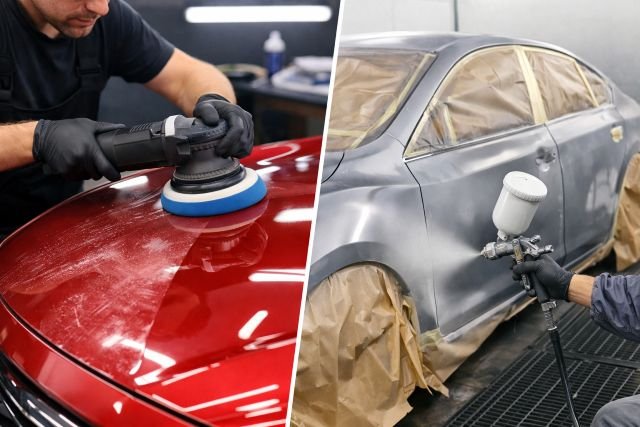
Paint correction is a professional machine-polishing process that removes defects from the clear coat — like swirl marks, water spot etching, oxidation, and micro-scratches — by carefully leveling the surface.
A full repaint is refinishing panels (or the entire vehicle) with new base coat and clear coat, often after extensive prep. Even quoting systems in collision repair separate paint labor and paint materials because prep and application are a big part of the total cost.
The biggest difference is what kind of damage you’re dealing with:
- Clear-coat-level defects → paint correction is usually the first (and cheaper) move.
- Base coat damage, primer showing, peeling clear coat, rust, or mismatched repairs → repainting (or at least partial respray) is often unavoidable.
How much is paint correction? Real-world price ranges
So, how much is paint correction in practice?
Most professional shops price it by vehicle size, paint condition, and how many polishing stages are needed. Typical real-world ranges are often quoted around $300–$1,500+ depending on severity and service level, with multi-stage correction rising further.
One-step vs. multi-stage correction
A one-step correction targets moderate swirls and haze and aims for “looks dramatically better” rather than perfection. Multi-stage correction uses progressively finer abrasives to chase deeper defects and refine gloss.
Also, correction isn’t “free” for the paint. Factory paint systems are often discussed in the ~100–180 micron total thickness range, with clear coat commonly cited around ~38–63 microns. That’s why reputable detailers measure paint, avoid sharp edges, and set realistic expectations.
Bottom line: paint correction is usually hundreds to a couple thousand dollars, not “new paint” money.
How much does it cost to repaint a car? Typical pricing tiers
Repainting costs swing wildly because quality swings wildly.
Authoritative consumer-facing sources commonly put a mid-range paint job in the low thousands. For example:
- AAA cites an average mid-range paint job around $1,000–$4,500 (varies by vehicle size and paint type).
- Kelley Blue Book notes that repainting an entire older sedan with faded paint can be around $3,000 as a realistic expectation, with costs varying based on many factors.
- CARFAX similarly frames professional painting as “at least a few thousand dollars” for quality results.
You’ll also see budget chain options advertised with estimators and entry packages, but prep work, repairs, and expectations matter a lot. (For example, Maaco offers an online estimator and discusses cost factors in their own material.)
The hidden driver of repaint cost: preparation
A repaint isn’t just spraying color. You’re paying for masking, sanding, dent/rust repair, panel alignment, blending, and curing time. That labor adds up quickly, especially if you want a finish that looks right in sun and lasts.
Cost comparison: paint correction vs repainting (quick decision view)
Here’s the simplest way to think about the cost gap:
- Paint correction: typically hundreds to low thousands when your existing clear coat is fundamentally intact.
- Repainting: often a few thousand for a professional result, and more if you’re doing high-end prep, color changes, jambs, or fixing prior poor repairs.
If your paint is salvageable, correction is usually the highest “wow per dollar” upgrade you can buy.
What factors change paint correction cost the most?
When you get quotes, the differences are usually driven by these variables:
1) Paint condition and defect depth
Light swirls and wash marring correct faster than heavy oxidation, etched water spots, or deep scratches.
If a scratch catches your fingernail, correction may improve it but not fully remove it—because it may be through the clear coat.
2) Vehicle size and body complexity
More surface area = more polishing hours. Curves, sharp lines, and tight areas also slow down the job.
3) Single-stage vs. multi-stage correction
More stages mean more time, more pad changes, more measurements, and more refinement.
4) What’s bundled with it
Many shops bundle correction with a ceramic coating or sealant. That can increase the ticket price but also extends the look and reduces re-marring.
What factors change repainting cost the most?
1) Quality tier (materials + labor standards)
Higher quality paint systems cost more, and higher quality labor costs more. AAA highlights how type of paint and shop quality affect the final price.
2) Repairs before paint
Rust repair and bodywork can easily surpass the paint cost itself on older vehicles.
3) Color change and “hidden areas”
Painting door jambs, engine bay edges, trunk channels, and removing trim/glass properly can dramatically increase time and cost.
4) Blending and panel matching
If you’re not painting the whole car, blending adjacent panels to match is often part of doing the job correctly, and estimating systems treat it as its own labor/material consideration.
Scenarios: which option is smarter (and why)
Scenario A: “My black car looks swirly in sunlight”
This is the classic paint correction case. You’re seeing wash marring and micro-scratches in the clear coat. A one-step or two-step correction usually transforms the look for far less than repainting.
If you maintain it properly afterward (safe wash + drying), the improvement lasts much longer.
Scenario B: “The hood is chalky and dull, but no peeling”
Oxidation and UV damage can often be corrected if the clear coat isn’t failing. Paint correction can restore gloss because it levels the degraded surface.
If the clear coat is too compromised, correction might help temporarily but won’t stop future failure.
Scenario C: “Clear coat is peeling on the roof”
Once clear coat is peeling, polishing can’t replace missing material. This is where repainting that panel (or more) becomes the correct fix.
Scenario D: “Car has a bunch of rock chips and deep scratches”
Paint correction can improve everything around chips and reduce the appearance of surrounding swirls, but it won’t fill missing paint. A combined approach often wins: touch-up + localized sanding (by a pro) + correction.
How to avoid wasting money: 6 practical tips
- Ask the shop whether defects are in the clear coat or below it. Paint correction only removes clear-coat-level defects by leveling the surface.
- For correction quotes, ask what level of improvement they’re targeting (e.g., 60–70% vs 85–95% defect removal). Perfection chasing gets expensive fast.
- Ask if they measure paint thickness before heavy correction. With clear coat commonly discussed in the tens of microns, this is a real safety consideration.
- For repaint quotes, ask what prep is included: trim removal, dent repair, rust treatment, primer/sealer steps, and warranty.
- If you’re repainting just one panel, ask how they’ll handle color match and blending.
- Protect your investment: correction without protection is like polishing your shoes and walking into mud. Consider ceramic coating or high-quality sealants.
FAQ
Can paint correction replace repainting?
Paint correction can avoid repainting when the issue is swirls, oxidation, haze, and light scratches in the clear coat. It cannot fix peeling clear coat, rust, or missing paint because it doesn’t add material—it refines what’s already there.
How long does paint correction last?
It depends mostly on how you wash and protect the car. With proper washing and protection, results can look great for years, but improper washing can reintroduce swirls quickly.
Is repainting always better than correction?
Not always. A mediocre repaint can look worse than original paint that’s been expertly corrected. Repainting makes sense when the paint system is failing or damage goes beyond the clear coat.
Why do repaint quotes vary so much?
Because prep, materials, labor standards, and scope vary. Consumer guides show mid-range jobs often land in the low-thousands, but complexity and quality can push it up significantly.
Conclusion: how much is paint correction compared to repainting?
If you came here asking how much is paint correction, the practical answer is: it’s usually the most cost-effective path when your paint is still structurally healthy and the problems are mostly swirls, haze, oxidation, and light scratches. Expect hundreds to low-thousands depending on vehicle size and correction level.
Repainting is a different category of expense — often a few thousand dollars or more for a professional result — because you’re paying for prep, materials, and skilled refinishing work.
A good rule: correct first when you can, repaint when you must. If you’re unsure, get a detailer and a body shop to evaluate the paint in person — then compare estimates based on the exact defects you’re trying to solve.