



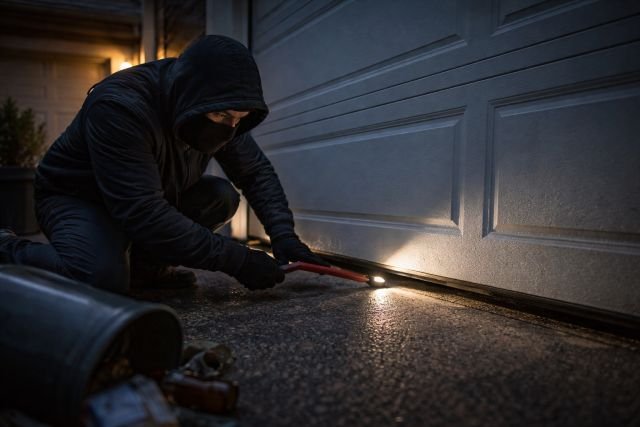
Most homeowners think of the front door as the main risk point — but in real break-ins, criminals look for the fastest, quietest path with the least visibility. For many houses, that’s the garage. If your garage door security is weak, you’re not just risking tools and vehicles — you may be giving someone a low-effort route into the living space, especially when the garage has an interior door into the home.
- What “garage door security” really means
- Sign 1: Your garage door has visible gaps or a “fishing” opportunity at the top
- Sign 2: You rely on a standard emergency release cord that can be reached from outside
- Sign 3: Your garage door opener is older — or lacks modern rolling-code protection
- Sign 4: Your garage door is “light” and flexes when pushed
- Sign 5: Your exterior garage service door (side/back door) is weaker than your front door
- Sign 6: Your garage is predictable — open at the same times, or left open “just for a minute”
- Sign 7: The garage-to-house interior door is not secured like an exterior door
- “Which signs matter most?” A quick risk table
- Actionable garage door security upgrades that give the most value
- Safety note: Don’t break safety features while “securing” the door
- Common questions (FAQ)
- Conclusion: Make your garage harder than the next house
The FBI reports that 55.7% of burglaries involved forcible entry (doors, windows, and other forced access points). That matters because a garage door is a huge “door” — and many garages have multiple vulnerabilities stacked together: predictable routines, older hardware, and overlooked gaps.
What “garage door security” really means
Garage door security is the combination of physical reinforcements, smart controls, and routine habits that prevent unauthorized access through the garage — whether that access is forced, “fished” through a gap, or gained digitally via a remote/code.
In plain terms: if someone can open your garage fast and quietly, your garage becomes a preferred entry point.
Sign 1: Your garage door has visible gaps or a “fishing” opportunity at the top
If your door doesn’t seal cleanly at the top (or has a warped panel, worn weather stripping, or a loose top seal), a thief can sometimes create a small opening and try to hook the emergency release. This tactic is widely discussed because it can be quick and doesn’t require loud forced entry.
Why it makes you a target
A small gap can become a “tool slot.” Even a narrow opening can allow someone to probe for the release cord/lever.
What to do (practical fixes)
- Replace cracked or flattened weather stripping and top seals.
- Check door alignment: if one side sits lower, the top corner is often the easiest spot to pry.
- If the top panel flexes, consider a reinforcement kit or a sturdier door material.
Featured snippet style tip:
A garage is an easy target when a thief can access the emergency release or lock area through a gap without making noise.
Sign 2: You rely on a standard emergency release cord that can be reached from outside
The emergency release is a safety feature designed for power outages, but some setups make it easier than it should be to manipulate from outside if there’s any access through the top.
Why it makes you a target
If someone can trigger the release, they may be able to manually lift the door.
Important: Some “quick hacks” people share online can create safety risks (for example, preventing proper emergency release during a real emergency). If you change how the release works, do it in a way that preserves safe operation.
Safer ways to reduce this risk
- Use a garage door shield/guard designed to block access to the release mechanism (a physical barrier rather than disabling the release).
- Shorten or reposition the cord so it’s not dangling near the top of the door.
- If you’re unsure, ask a garage door technician to recommend a compliant solution that keeps emergency egress usable.
Sign 3: Your garage door opener is older — or lacks modern rolling-code protection
Older remotes and openers can be easier to exploit. Modern systems typically use rolling codes or more secure pairing methods, making code capture/replay much harder.
Why it makes you a target
Security isn’t only about the door panel. It’s also about the “key” (remote/app). If your opener is from an older generation, you may be using weaker signal security or outdated logic.
How to spot it
- Your opener uses DIP switches (tiny physical switches) for code settings.
- You can’t find any mention of rolling code / encrypted pairing in the manual.
- You’ve never updated your opener despite years of daily use.
Fix
- Upgrade to a modern opener with rolling-code tech and smart monitoring.
- Reset and re-pair remotes if you’ve moved into a home (you don’t know who still has a programmed remote).
Sign 4: Your garage door is “light” and flexes when pushed
Do this test: with the door closed, press firmly on a panel section (not the windows). If it flexes easily, it may be easier to pry or bow enough to create access points near the latch/track.
Why it makes you a target
A flexible door can be manipulated with less force — and less noise — than a reinforced door. It also makes gaps worse over time.
Best upgrades for stronger garage door security
- Add a reinforcement strut (commonly used on wide doors).
- Upgrade to a thicker steel door (or a better-insulated model, which often has stronger construction).
- Ensure tracks and brackets are tightened and not pulling away from framing.
Sign 5: Your exterior garage service door (side/back door) is weaker than your front door
This is a common blind spot. Homeowners reinforce the front entry, but the side garage door might have a basic lock, a flimsy frame, or even a window that can be broken to reach an interior thumb-turn.
Why it makes you a target
A thief will choose the least resistant entry, not the most obvious one.
Quick checklist (easy wins)
- Use a solid-core door with a quality deadbolt.
- Reinforce strike plates with longer screws into framing.
- Add motion lighting covering the service door area.
If you want related reading on your site, link internally to pages like: “How to Reinforce Exterior Doors” and “Motion Lighting Placement for Home Security.”
Sign 6: Your garage is predictable — open at the same times, or left open “just for a minute”
Routine is a burglar’s best friend. The easiest “break-in” is no break-in at all: an open door during school pickup, dog walks, or quick errands.
Why it makes you a target
Criminals often look for opportunity, not confrontation. If your garage is routinely open, it becomes low-risk access.
Real-world scenario
A neighbor sees your garage open daily at 3:15–3:45 PM. So does anyone else driving by. Someone doesn’t need to “hack” anything—they only need to walk in, grab items, or slip to the interior door if it’s unlocked.
Fix
- Use an auto-close timer (many smart openers support this).
- Turn on real-time alerts (“door opened” / “door left open” notifications).
- Create a habit trigger: “Car in park → door down.”
Sign 7: The garage-to-house interior door is not secured like an exterior door
This one is huge. Even if the main garage door is strong, the interior door is often a simple hollow-core slab with a basic handle lock — meaning once someone is in the garage, the home entry is much easier.
Why it makes you a target
The garage can become a private staging area — hidden from neighbors and street view. That gives a burglar time.
What “good” looks like
- Solid-core or steel interior garage door
- Deadbolt or high-quality locking hardware
- Door closer (so it never stays accidentally open)
“Which signs matter most?” A quick risk table
| Sign | Risk Level | Why it matters most |
|---|---|---|
| Interior door is weak | Very High | Turns garage access into home access |
| Predictable open-door routine | High | No forced entry needed |
| Door has gaps / fishing opportunity | High | Quiet, quick access attempt |
| Older opener/security | Medium–High | Weak “keys” undermine strong doors |
| Flexible door panels | Medium | Easier to pry/bow than reinforced models |
| Weak service door | Medium–High | Often less visible and less reinforced |
| Poor lighting/no alerts | Medium | Increases time and privacy for intruders |
Actionable garage door security upgrades that give the most value
If you only do a few things, prioritize the upgrades that reduce time, privacy, and silence — the three advantages intruders want.
1) Add layered deterrence
- Motion lighting (exterior corners + garage service door)
- Visible camera or video doorbell coverage
- “Door open” alerts + auto-close
2) Harden the garage-to-home boundary
Treat the interior door like an exterior door.
3) Modernize access control
Upgrade older openers and reset pairing after moves or lost remotes.
Safety note: Don’t break safety features while “securing” the door
Garage door systems include safety standards aimed at preventing injuries, especially around automatic operation. Industry resources describe UL 325 as a safety standard covering automatic operation of garage doors and related systems.
If a security tweak prevents safe emergency release or interferes with safe operation, choose a different method (like shielding/guarding access) or consult a professional.
Common questions (FAQ)
Is the garage really a common entry point for burglars?
Some security research summaries report the garage is used as an access point in a minority of break-ins (often cited around single digits), but it’s still significant because the garage can provide hidden access and a path into the home.
What’s the biggest garage security mistake homeowners make?
Leaving the garage door open — even briefly — or failing to secure the garage-to-house interior door like an exterior entry.
Should I lock my garage door from the inside at night?
If you’re away for extended periods, using a manual lock or interior slide lock can add security — just make sure everyone in the household understands how it works and that it doesn’t create safety issues for emergency operation.
Do smart garage door openers improve security?
They can — especially with real-time alerts, auto-close timers, and better access management. They also help you catch “door left open” incidents immediately.
Conclusion: Make your garage harder than the next house
Strong garage door security is less about one magic product and more about removing “easy target” signals: gaps, predictable routines, outdated access control, and weak interior doors. The FBI’s data shows forcible entry is still common in burglaries, which is exactly why reinforcing big, overlooked openings like the garage matters.
Start with the highest-impact fixes: secure the garage-to-home door, eliminate obvious gaps, modernize your opener access, and add lighting/alerts. Once your garage becomes noisy, time-consuming, and visible to approach, most opportunistic intruders move on.